
The Model Train Hobby for Adults Beginners: A Practical 12-Week Blueprint from Someone Who's Been There
Posted by Gerald Hoffmann on 31st Dec 2025
Order by phone: 763-231-7847
Free Shipping On Orders Over $100!
If you are already registered, please log in.
Create your account and enjoy a new shopping experience.
Create A New AccountPosted by Gerald Hoffmann on 31st Dec 2025
I spent 35 years working for Burlington Northern Santa Fe before I retired in 2019, and I've been building model railroads almost as long as I worked on the real ones. After watching countless friends and acquaintances try to get into this hobby only to give up in frustration, I wanted to put together the guide I wish someone had handed me back when I was fumbling around in my first hobby shop.
Here's what I know for certain: beginners who get a train running reliably on a small, finished layout stick with this hobby for life. Those who buy too much, plan too big, and never complete anything? They're selling their stuff on eBay within two years. This guide is about getting you into that first group.
You might think model railroading is a dying hobby for old guys like me. You'd be wrong. The global model train market is projected to grow from $1.18 billion in 2024 to $2.22 billion by 2033. That's not a hobby in decline.
What's driving this? Younger adults are discovering that building something with their hands beats scrolling on a phone. During lockdowns, Hornby saw sales surge by 33% as people rediscovered hobbies that don't require a screen. That interest hasn't gone away.
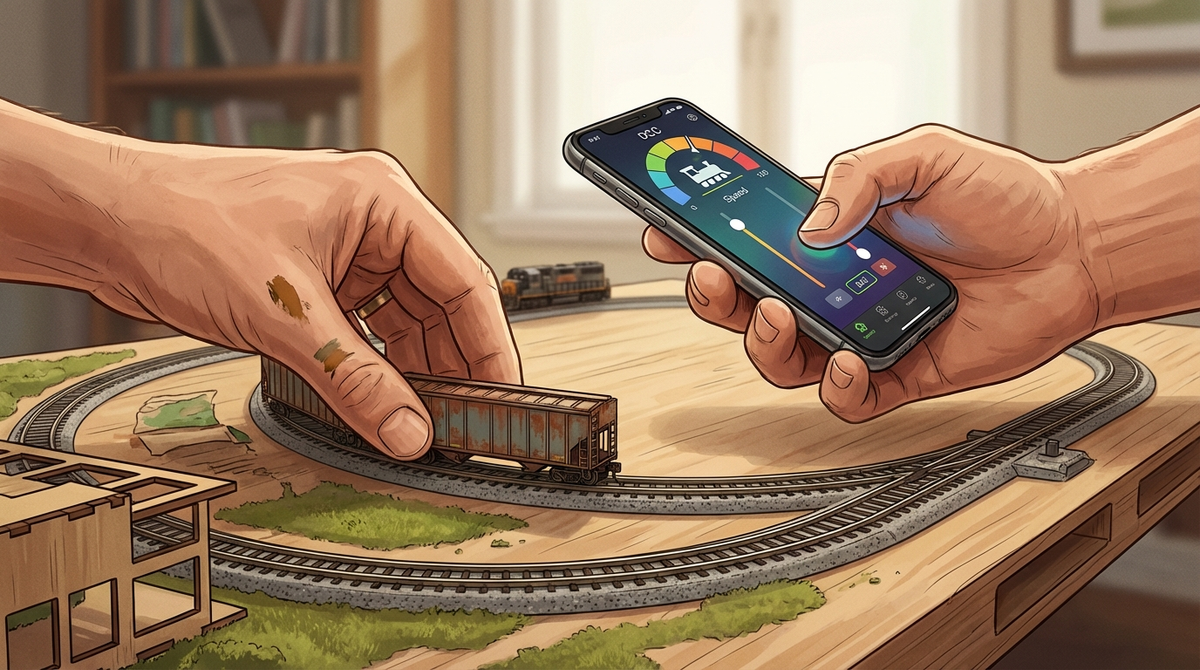
The technology has caught up too. When I started, you needed a degree in electrical engineering to run multiple trains. Today, you can control your whole layout from your smartphone. Wi-Fi throttles, Bluetooth decoders, and app-based systems have slashed the learning curve dramatically.
I need to be honest about something. The National Model Railroad Association has faced declining membership for 30 years, with the average member being a male over 60 and the mean age around 72. Many younger hobbyists tell me they find traditional clubs unwelcoming.
Don't let that discourage you. The hobby itself is thriving online, at shows, and in garages and basements across the country. You don't need a club membership to build a layout that brings you joy. Start at home, build your skills, and seek out community when you're ready.
Scale refers to the size of your models compared to the real thing. This single choice affects everything: how much space you need, what you can afford, and how detailed your models will be.
HO scale (1:87) remains the most popular choice in North America for good reason. The models are large enough to handle easily and see detail clearly, yet small enough to fit a respectable layout in a spare bedroom. Almost every prototype locomotive and freight car you could want is available from multiple manufacturers.
N scale (1:160) is roughly half the size of HO. If you're working with an apartment or limited space, N scale lets you build expansive scenes with long trains in a footprint that would only accommodate a simple oval in HO. The trade-off is smaller details and components that require steadier hands.
Forget the classic 4x8-foot sheet of plywood that every old magazine recommended. Most adults don't have a dedicated train room, and that's perfectly fine.
For N scale, you can build a complete, operating layout on a hollow-core door (36x80 inches). That fits in a closet when you're not running trains.
For HO scale, consider a shelf layout. Keep the depth to 18 inches or less, which prevents back strain when reaching for derailed cars and makes construction much simpler. A shelf running along one wall of a spare room gives you more operating interest than a cramped 4x8 ever could.
Let me give you straight numbers based on what things actually cost, not what manufacturers hope you'll spend.
A quality starter set runs $180-250 for HO scale. Add $75-150 for benchwork materials, another $50-100 for additional track, and $50-75 for basic tools. You're running trains for under $500.
Step up to a DCC-equipped starter set or add a separate DCC system like the NCE Power Cab. Add a couple of quality freight cars, better track (I recommend Kato Unitrack), and scenery materials. You'll have a layout that looks and operates like you've been doing this for years.
Sound-equipped locomotives, premium rolling stock from manufacturers like Tangent and ExactRail, a quality soldering station, and an airbrush for weathering. This is where the hobby really opens up, but you don't need to start here.
Buy used rolling stock. Train shows and eBay are full of cars that run perfectly fine and just need a coupler upgrade. Upgrade budget cars with metal wheels and Kadee couplers. You'll spend $10-15 per car and get operation that rivals cars costing three times as much.
Make your own scenery. Real dirt, crushed leaves, and craft store supplies work better than expensive hobby products and cost a fraction of the price.
Here's the roadmap that gets you from unboxing to operating. Don't skip steps, and don't buy ahead.
Unbox your starter set and assemble the included track on a table or floor. Run your locomotive and cars. Get familiar with the controls. Identify any problems with the equipment now, while returns are still an option. Cost: Your starter set.
Finalize a small track plan. For your first layout, I recommend something based on proven designs from Kato's N scale plans or HO track plans. Build a simple benchwork frame or use a hollow-core door on sturdy supports. Cover it with extruded foam insulation board. Cost: $75-150.
Install cork or foam roadbed. Lay and secure all track and turnouts according to your plan. Don't rush this. Poor trackwork causes more frustration than anything else in this hobby. Use Kato Unitrack for reliable, quick results, or flex track from Micro Engineering or Atlas for more prototypical appearance. Cost: $100-200.
This is where many beginners stumble. The NMRA's wiring guide covers the fundamentals. The key principle: don't rely on rail joiners to conduct electricity. Run a power bus of 14-16 gauge wire under your layout and solder feeder wires to every piece of rail. Cost: $50-100.
Paint your foam base with earth-toned latex paint. Apply ground cover using the techniques in Woodland Scenics' instructions. Build one or two simple structure kits. Don't try to do everything at once. Cost: $75-150.
Apply basic weathering to a few freight cars using powders or washes. Develop a simple switching puzzle. Run your first operations session. You're now a model railroader. Cost: $50-100.
You have two main choices for track: roadbed systems like Kato Unitrack or conventional flex track.
Kato Unitrack and Bachmann E-Z Track both feature track pre-mounted on plastic roadbed that snaps together. For beginners, Kato Unitrack is the clear winner. Its connections are rock-solid, and its turnouts work reliably. Bachmann E-Z Track comes in many starter sets, but its turnouts are notorious for causing derailments and electrical problems.
If your starter set includes E-Z Track, use the straight sections and curves but budget to replace the turnouts with Kato or Peco.
The "frog" is where rails cross inside a turnout. Peco's Unifrog design works out of the box for DCC and can be wired for powered frogs later. It's the best choice for beginners who don't want to think about this yet but want room to grow.
Digital Command Control (DCC) sends digital signals through the track to decoders in each locomotive, allowing you to control multiple trains independently. Traditional DC requires complex block wiring to achieve the same thing.
My advice: start with DCC. The entry cost is comparable, the learning curve is gentler than you'd think, and you won't have to rewire everything later.
The NCE Power Cab at around $195 is the system I recommend most often. It's intuitive, expandable, and well-supported. The Digitrax Zephyr Express is another solid option in the same price range.
Once you have a DCC system, you can add Wi-Fi throttle capability through JMRI software. Run your trains from your smartphone using free apps like Engine Driver or WiThrottle. It's surprisingly intuitive.
For the absolute simplest setup, SoundTraxx Blunami decoders use Bluetooth to connect directly to your phone. No command station needed. Just power to the track and a decoder in your locomotive. It's almost too easy.
DCC++EX is an open-source command station you can build from an Arduino for under $60. If you're comfortable with basic electronics and enjoy tinkering, it's a capable and extremely affordable path into DCC.
Don't design your own first layout. Use something proven. You'll learn the principles while building, and you'll actually finish.
This classic switching layout fits on a coffee table and offers real operating interest. You can switch cars between industries, run a continuous loop, and expand later if you want. Kato provides a complete Unitrack parts list.
The Scenic Ridge layout fits on a standard hollow-core door and includes elevation changes, a tunnel, and a bridge. Woodland Scenics sells a complete terrain kit designed specifically for this plan, making scenery straightforward.
Good scenery comes from layering, not talent. Here's the workflow I teach my grandkids.
Start with extruded foam as your base. Cover it with plaster cloth if you want hard-shell terrain. Paint everything an earth color before adding any texture. While the paint is tacky, sprinkle on fine ground foam. Add variety with different colors on top.
Static grass applicators make fields look realistic instead of like green felt. Apply grass glue, then use the applicator to stand the fibers upright. Layer different lengths and colors for the best effect.
Use pre-made armatures from Woodland Scenics. Apply Hob-e-Tac adhesive, wait for it to dry clear, then dip in clump foliage. Ten minutes per tree, and they look better than most pre-made trees you can buy.
Nothing separates a toy from a model faster than weathering. Powdered pastels are the easiest entry point.
Spray your model with matte varnish to give the smooth plastic some tooth. Apply rust, dirt, and grime colors using a soft brush or makeup applicator. Focus on areas where dirt would naturally collect. Seal with another light coat of matte varnish.
Your first weathered car won't be perfect. Your tenth will be impressive. Start with inexpensive cars and practice.
Stick with authorized dealers. For locomotives and decoders especially, manufacturer warranties typically apply only to products purchased from authorized sources.
TrainWorld, Model Train Stuff, and Charles Ro have been in business for decades. They stand behind what they sell.
Bachmann offers a limited lifetime warranty on motorized units, but it requires proof of purchase and doesn't cover used items or user modifications. Athearn operates a dedicated service center for repairs. Keep your receipts.
Be cautious about deals on AliExpress or eBay that seem too good to be true. DCC decoders store a manufacturer ID in Configuration Variable 8. If you read that value and it doesn't match the brand on the packaging, you've got a fake.
Use manufacturer dealer locators to find authorized sources for anything expensive.
You don't need a club to enjoy this hobby, but connecting with other modelers accelerates your learning and adds to the fun.
The NMRA is organized into local divisions that host layout tours, operating sessions, and hands-on clinics. Many divisions are more welcoming than the national organization's demographics might suggest. Your local division is worth checking out.
Instead of building a large home layout, consider building standardized modules that connect with others at shows. T-TRAK uses small, tabletop modules based on Kato Unitrack. Free-mo focuses on prototypical operations and realistic scenery. Both get you operating with others quickly.
The Amherst Railway Society Railroad Hobby Show is the largest railroad-themed trade show in America. The Great Train Show travels to cities across the country. Shows are fantastic for seeing layouts, talking to manufacturers, and finding deals.
The NMRA Beginner's Guide covers the fundamentals thoroughly. For DCC wiring specifics, Allan Gartner's site remains the definitive resource. Forums at trains.com and mrhmag.com are invaluable for getting questions answered.
I'll be honest: after I retired, I struggled. Thirty-five years of work, and suddenly nothing needed me. Model railroading gave me purpose again.
Research backs this up. A meta-analysis of multiple studies found that engaging in hobbies correlates with fewer symptoms of depression. Creative hobbies reduce stress and anxiety. Cognitively stimulating activities are linked to lower risk of cognitive decline.
This hobby combines art, history, and engineering. You're solving problems, learning new skills, and creating something tangible. That's good for your brain and your spirit.
The path from curiosity to lifelong hobbyist runs through one completed project. Not a dream layout that takes a decade. Not a collection of boxes in a closet. One small layout, scenicked and operating, that you can be proud of.
Follow the 12-week plan. Resist the urge to buy everything at once. Ask questions when you get stuck. And remember that every expert modeler you admire started exactly where you are now.
I'll be at my workbench in Duluth if you need me. The Lake Superior Railroad Museum is always worth a visit if you're in the area. And my grandkids say hi.
✨ Complete Your Layout: Explore our wide selection of Photo Real buildings, diorama backdrops, detail parts, and accessories in every popular scale.
✨ Unmatched Realism: From chrome detailing products to neon lighting kits – every piece is designed to make your miniature world come alive.