
Model Train Hobby Essential Tools List: What You Actually Need on Your Workbench
Posted by Tony Marchetti on 15th Feb 2026
Order by phone: 763-231-7847
Free Shipping On Orders Over $100!
If you are already registered, please log in.
Create your account and enjoy a new shopping experience.
Create A New AccountPosted by Tony Marchetti on 15th Feb 2026
After 28 years turning wrenches at the CTA Skokie Shops, I thought I knew tools. Then I tried to wire my first DCC layout and realized model railroading has its own language. The difference between a layout that runs smooth and one that sends you crawling under the benchwork every other night? It comes down to what's in your toolbox.
I've watched guys spend thousands on brass locomotives, then wonder why their trains derail on every turnout. Meanwhile, they're using a rusty pair of diagonal cutters from the hardware store and haven't touched an NMRA gauge in years. Look, I get it. Buying tools isn't as exciting as buying trains. But here's the thing: four out of five derailments trace back to out-of-spec wheels or track that a $22 gauge would have caught before the locomotive ever hit the rails.
Let me walk you through what actually belongs on your workbench.
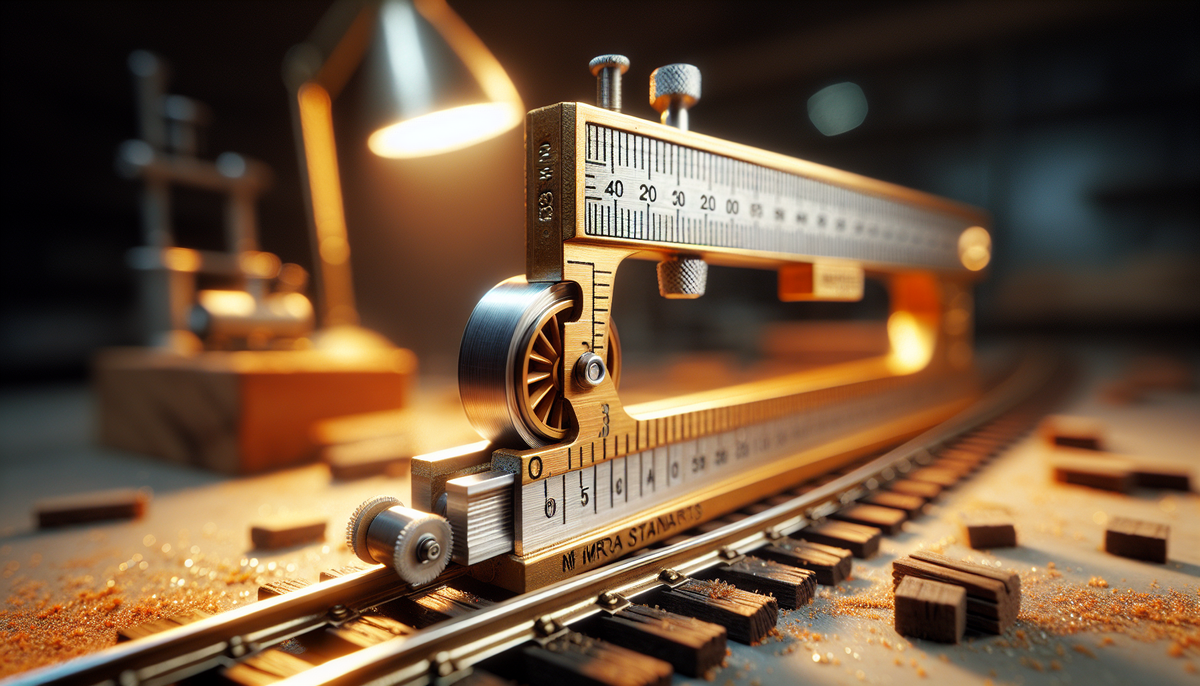
I'm talking about the NMRA Standards Gauge. This little sheet of stamped metal is the single most important tool you'll own. Period. If you don't have one for your scale, stop reading and go buy one.
Every new piece of rolling stock that enters my layout gets checked before it touches the main line. Out-of-gauge wheels cause more derailments than any other factor, and I've seen brand-new cars straight from the box with wheels that wouldn't pass muster. Takes two minutes to check. Saves hours of troubleshooting.
The gauge checks track gauge, wheel back-to-back spacing, flangeway depth, turnout clearances, and platform height. The NMRA publishes these standards so your equipment works with everyone else's. When your wheels fit snugly in those stepped slots without binding or play, you're golden.
Your NMRA gauge handles the wheel-rail interface. For couplers, you need a Kadee coupler height gauge. Runs about eight to twelve bucks depending on scale. Worth every penny.
Kadee's multi-purpose gauge checks coupler centerline height, trip pin clearance, and uncoupler height. If you're running N scale, Micro-Trains makes their own version designed for their couplers. The top of your couplers should match the top of the coupler on the gauge.
Here's my intake routine for every new car:
Stubborn wheels? NWSL and Micro-Mark sell wheel pullers that won't damage the axle or wheel face. The Micro-Mark truck tuner can ream bearings to the NMRA's recommended 60-degree contour, reducing friction so cars roll better.
Back at CTA, we had a saying: right tool, right job. Same applies here. Using your track cutter on piano wire is like using a torque wrench as a hammer. Sure, you can do it once. Maybe twice. Then you're buying a new tool.
Xuron estimates 35% of warranty returns on their popular 2175B track cutters are jaws destroyed by cutting the wrong material. A twenty-five dollar precision tool, trashed because someone tried to snip hardened wire.
| Tool | What It Cuts | Price Range |
|---|---|---|
| Xuron 2175B Track Cutter | Nickel-silver or brass rail up to Code 100 | $17-26 |
| Xuron 2175M Vertical | Track already laid (vertical head protects roadbed) | $20-25 |
| Xuron 2175ET Sprue Cutter | Soft plastic parts from sprues | $18-25 |
| Xuron 170-II Flush Cutter | Soft wire up to 18 AWG, component leads | $15-18 |
The 2175B uses Micro-Shear action to give you a square, flush cut on one side. That matters for rail joints. After cutting, a few light passes with a needle file squares the end for a tight fit in the rail joiner.
Get yourself a set of Swiss pattern needle files from Grobet or Vallorbe. The cheap import sets dull fast. Good files last years.
Here's a stat that'll make you wince: modelers using sub-$40 unregulated soldering irons report three times more rework due to cold solder joints than those with temperature-controlled stations. Each failed joint takes about eleven minutes to diagnose and fix. Add that up over a layout's worth of wiring.
When I wired feeders with a cheap iron, I thought I was saving money. Then I spent a weekend chasing a dead spot that turned out to be a bad joint I'd made six months earlier. The "savings" evaporated real quick.
| Station | Power | Temp Range | Key Features | Price |
|---|---|---|---|---|
| Hakko FX-888DX | 65W | 120-899°F | 5 presets, ±1.8°F stability, ESD safe | ~$120-142 |
| Weller WE1010NA | 70W | 200-850°F | Tool-less tip change, auto setback | ~$115-198 |
| Pinecil V2 | Up to 88W | 212-752°F | USB-C powered, 6-second heat-up, portable | ~$26 |
The Hakko FX-888D is what thousands of industries use. Fast thermal recovery means you can solder a feeder wire without melting the plastic tie next to it. The Weller has excellent ergonomics and that tool-less tip change is nice when you're switching between tasks.
The Pinecil V2 is the surprise winner for guys who want station-level performance without the bulk. Runs off USB-C power, heats up in six seconds, and the open-source firmware lets you tweak it to your heart's content. Twenty-six bucks for the iron (you supply the power adapter). That's a bargain.
This trips up beginners constantly. Use 63/37 or 60/40 tin-lead rosin-core solder for model railroad work. The 63/37 alloy has a lower melting point and goes from liquid to solid instantly without any pasty phase. Makes cleaner joints.
Lead-free solder has a higher melting point, which means more heat, more dwell time, and more risk of melting plastic or damaging decoders.
And here's the one that'll save your layout: never use acid flux for electronics. Plumbing flux is acidic and will eat through your connections over time. Rosin flux only. This is non-negotiable.
You can't fix what you can't see. Running a DCC layout without proper diagnostic tools is like trying to diagnose a car problem without gauges. Sure, sometimes you get lucky. Most times you don't.
Digital Multimeter: Use it with power OFF to check continuity and hunt for shorts. Resistance near zero ohms means a short; infinite resistance means an open circuit. Also useful for measuring DC voltage at decoder motor outputs.
RRampMeter: This is the game-changer. Standard multimeters can't accurately read DCC's square-wave signal. They'll give you false readings that send you chasing ghosts. The DCC Specialties RRampMeter provides true RMS voltage and current readings, letting you diagnose voltage drop and quantify locomotive current draw. Service logs from Tony's Train Exchange show layouts diagnosed with an RRampMeter located voltage sag issues 44% faster.
Decoder Tester: Units like the NCE DTK or ESU 51900 let you test motor, function, and sound outputs on the bench before installation. Beats tearing apart a locomotive to find out the decoder was bad all along.
Your DCC system needs a low-resistance power bus to function properly. Use 12-14 AWG solid copper wire for the main bus on most HO layouts. Feeders can be 22-24 AWG stranded wire for short drops from the bus to the track.
Solder all connections. Crimps and wire nuts work in a pinch, but soldered joints are more reliable long-term. A good self-adjusting wire stripper makes clean, nick-free strips every time.
Here's one that drives me crazy. Guys attack their track with abrasive blocks like they're sanding rust off a bumper. Laboratory microscopy shows that just 10 passes with a "Bright Boy" creates micro-scratches up to 1.2 microns deep. Those scratches double dirt adhesion and contributed to a 0.4V voltage drop over a 20-foot section after 100 hours of running in tests.
You're creating the problem you're trying to fix.
For routine cleaning, use a lint-free cloth with 99% isopropyl alcohol. Reserve abrasives only for heavily oxidized brass track that needs restoration, not maintenance.
Running trains is great. Running trains through a believable world is better. Here's what you need to create that world.
Static grass changed model railroad scenery. Instead of flat flock, you get grass fibers standing upright like the real thing. The applicator uses an electrostatic charge to make this happen.
| Applicator | Power Source | Best For | Price |
|---|---|---|---|
| Noch Gras-Master 3.0 | 9V Battery | Compact, 3-4 hour battery life | ~$150 |
| Woodland Scenics Static King | 9V or Mains | Large areas, 2-12mm fibers | ~$80-100 |
| WWS Pro Grass Grand | 9V Battery | 1mm-12mm fibers, robust build | ~$70-90 |
| WWS Pro Grass Micro | 9V Battery | Detail work, smaller areas | ~$50-60 |
An airbrush gives you smooth base coats and realistic weathering that brushes can't match. For beginners and general work, the Badger Patriot 105 handles properly thinned paints well with its forgiving 0.5mm nozzle.
Ready to step up? The Iwata Eclipse HP-CS is legendary for reliability. Its 0.35mm nozzle balances fine line control with wider spray patterns. I've used one for years on everything from rolling stock to structures.
You'll also need a compressor with a tank and moisture trap plus a spray booth with proper ventilation. More on that in the safety section.
Using the wrong adhesive is a recipe for weak joints and damaged parts. Here's the quick reference:
| Materials | Best Adhesive | Notes |
|---|---|---|
| Styrene to Styrene | Solvent Cement (Tamiya Extra Thin, Plastruct Plastic Weld) | Creates a weld; strongest possible bond |
| Resin Parts | CA (Cyanoacrylate) Medium or Thick | Wash parts first to remove mold release |
| Metal to Plastic | CA or 5-Minute Epoxy | Epoxy for gap-filling strength |
| Wood to Wood | Aliphatic Resin (Titebond) | Stronger than PVA; requires clamping |
| Scenery (Foam, Ballast) | PVA or Matte Medium | Dilute with water for application |
Thick CA works for filling small gaps, but for large gaps on metal, 30-minute or 24-hour epoxy gives structural strength.
I worked around hazardous materials for almost three decades. You learn to respect them. Model railroading involves chemicals and processes that need the same respect.
Rosin flux fumes are a known respiratory sensitizer and can cause occupational asthma. MIT's safety guidelines recommend local exhaust ventilation with the capture hood within five inches of the work.
Budget fume extractors with HEPA and activated carbon filters run under $90 and make a real difference. For frequent soldering, pair it with an OV/P100 respirator.
Enamel and lacquer thinners release VOCs that shouldn't be inhaled. OSHA requires spray booths to maintain 100 fpm airflow. A 2025 NIOSH study found only 27% of home workshops meet this standard.
At minimum, get a half-face respirator with OV cartridges (like 3M 60921). ANSI Z87.1 safety glasses protect your eyes from overspray.
If you're printing your own detail parts, uncured resin is a skin sensitizer. Wear chemical-resistant nitrile gloves (latex isn't enough) and operate the printer in a well-ventilated area away from living spaces.
Keep a Class ABC fire extinguisher accessible. It covers combustibles, flammable liquids, and electrical fires.
You don't need to buy everything at once. Build your toolkit as your skills grow.
Focus on the basics that won't need immediate replacement:
Add precision and new capabilities:
Precision scratchbuilding and diagnostics:
I've made all of these. Learn from my pain.
Over-tightening truck screws: Trucks need slop to navigate irregular track. Tighten fully, then back off a quarter to a full turn.
Using the wrong cutters on rail: Diagonal cutters deform the rail profile. Use proper rail nippers with the flat side against the good end.
Skipping the gauge check: That derailment on your new turnout? Probably an out-of-gauge wheelset you never checked.
Aggressive track cleaning: Alcohol and a soft cloth for maintenance. Save the abrasives for restoration jobs.
Acid flux on electronics: It will destroy your connections over time. Rosin flux only.
Micro-Mark is the go-to source for specialized hobby tools you won't find anywhere else. They ship worldwide with a 30-day return policy.
Walthers has the widest selection of model railroad products, though backorders are common. TrainWorld often has better prices but stock status can be unreliable.
For UK and European products, Rails of Sheffield ships worldwide. Gaugemaster manufactures their own controllers and has strong European selection.
Buy direct from Kadee, Xuron, and Woodland Scenics when you want guaranteed authentic products.
Watch out for counterfeit soldering tips on Amazon and eBay. Fakes use inferior metallurgy and wear out fast. Buy consumables from authorized distributors.
USB-C powered smart soldering irons are already here and delivering station-level performance in a portable package. Cordless micro-tools from Ryobi and Worx are getting lighter and more powerful.
AI is helping with layout planning, condensing months of conceptual design into days. Hobbyists are using ChatGPT for brainstorming themes and optimizing operations. Visual track plans aren't practical yet, but they're coming. Use AI for initial planning, then execute in proven software like AnyRail or SCARM.
Digital inspection microscopes are replacing magnifying lamps for precision work. Once prices drop below $200 for good units, they'll become standard equipment.
The right tools make the difference between fighting your layout and enjoying it. Start with the basics, upgrade when limitations cost you more in time than the tool would cost in money, and remember: the guy with the $22 NMRA gauge who uses it will always outperform the guy with $500 in fancy equipment gathering dust.
✨ Complete Your Layout: Explore our wide selection of Photo Real buildings, diorama backdrops, detail parts, and accessories in every popular scale.
✨ Unmatched Realism: From chrome detailing products to neon lighting kits – every piece is designed to make your miniature world come alive.