
How to Weather N Scale Trains: A Practical Guide to Realistic Miniatures
Posted by Harold Lindgren on 31st Dec 2025
Order by phone: 763-231-7847
Free Shipping On Orders Over $100!
If you are already registered, please log in.
Create your account and enjoy a new shopping experience.
Create A New AccountPosted by Harold Lindgren on 31st Dec 2025
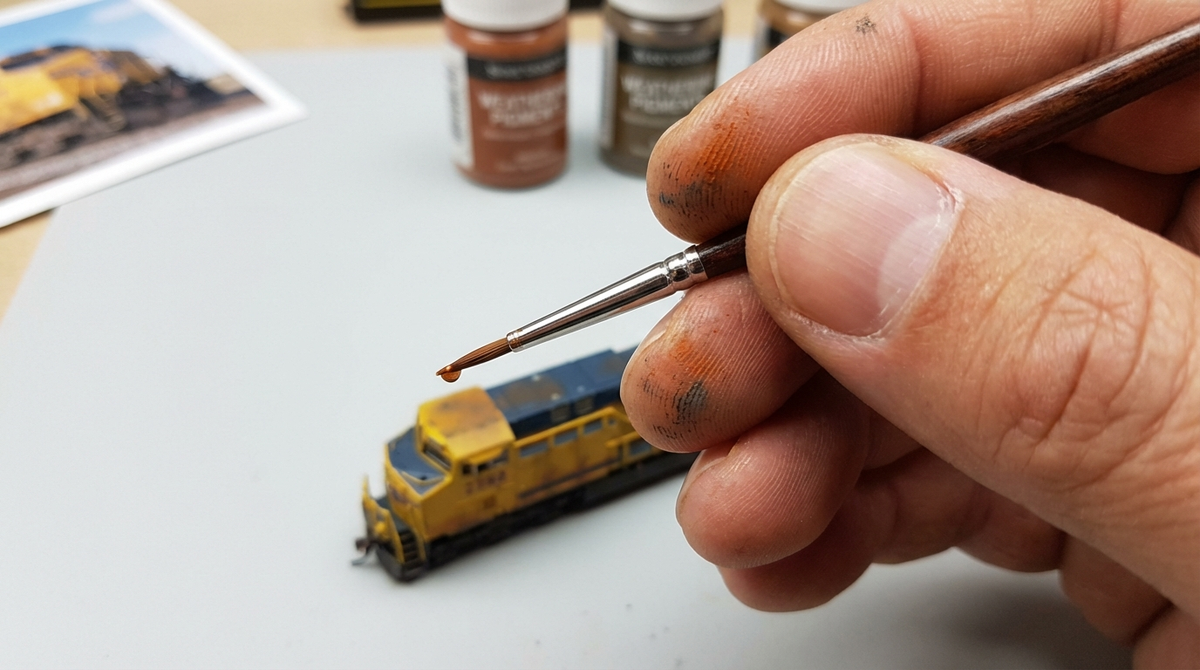
I'll admit something up front: I model the Soo Line in HO scale. My benchwork, my trackwork, my rolling stock-all HO. But when a friend asked me to help weather his N scale fleet last winter, I learned a humbling lesson. Everything I knew about weathering needed recalibration. The margin for error at 1:160 scale? Almost nonexistent.
After forty years swinging hammers and running crews, I thought I understood precision. Turns out, weathering N scale trains demands a level of restraint that makes finish carpentry look sloppy. A blob of paint that measures 0.2mm on your model translates to a full inch on the real thing. Apply too much grime, and your locomotive looks like it survived a coal mine explosion. The goal is subtlety-and subtlety, as I learned, is harder than it sounds.
Right out of the box, N scale locomotives and freight cars look clean. Too clean. That factory-fresh sheen screams "toy" to anyone who's watched real trains roll by. Weathering rolling stock changes everything. It adds the story of miles traveled, coal dust accumulated, and rainstorms survived.
The weathering models community on TikTok has exploded with creators showing quick techniques, and there's a reason for that enthusiasm. When you weather a car correctly, you're not just adding dirt. You're adding depth, shadow, and dimension that makes the eye believe. A weathered locomotive catches light differently. Panel lines pop. Rivets become visible. The plastic shell transforms into something that looks like steel.
Here's something most guides skip: the physics of viewing small objects affects how we perceive color. At N scale, your model is visually "farther away" even when you're holding it at arm's length. This lightens how colors appear to your eye. The practical result? Prototype-matched paint colors often look too dark or intense on the model. You need to lighten everything slightly to compensate, especially if your layout room runs dim.
The same principle applies to weathering effects. A chip that looks subtle at HO scale becomes a massive peel in N. Cody Grivno's work on Canadian Pacific locomotives demonstrates how restraint produces realism. He builds up effects in thin layers, stopping well before instinct says to stop.
You can weather N scale trains for less than a dollar per car using basic supplies, or you can invest in professional-grade equipment. The difference isn't just price-it's control. Let me break down what works at each level.
According to the NMRA's beginner weathering guide, you can achieve satisfying results with artist's pastel chalks, Testors Dullcote, basic brushes, and cotton swabs. Total investment: around $45. The chalks provide pigment, the Dullcote seals it, and the brushes give you application control. A single set of chalks will weather over 100 cars before needing replacement.
The beauty of this approach? Low stakes. If you mess up a $15 boxcar while learning, you haven't burned through expensive materials. And honestly, sympathetic weathering on any gauge starts with the same principles: observe prototypes, apply sparingly, build in layers.
Once you've weathered a dozen cars with chalks, you'll want more options. Fast, realistic techniques for locomotives and freight cars become possible when you add PanPastels, artist's oil paints, and pre-made washes to your arsenal.
PanPastels deserve special mention. Their sales have grown 290% year-over-year according to industry data, and I understand why. The pigment grinds finer than traditional chalks, applies more evenly, and creates softer fades. Add a set of Vallejo Model Washes and some odorless mineral spirits for oil work, and you're equipped to tackle any weathering challenge short of airbrushing.
An airbrush changes everything. When you can lay down a fade coat so thin it barely registers visually, you control exactly how much weathering builds on your model. The AMMO by MIG Jimenez product line includes specialized weathering enamels formulated specifically for these subtle applications.
For N scale, nozzle size matters. A 0.3mm tip at 15-20 PSI produces a spray pattern equivalent to about 7.5 inches at prototype scale-perfect for general fading and dust coats. Drop to a 0.2mm nozzle at 10-12 PSI and you can halve the apparent size of chips and streaks. That precision costs money, but forum discussions consistently rank airbrush control as the biggest jump in weathering quality.
Here's a statistic that should wake you up: 11% of N scale DCC service tickets in 2024 traced back to weathering damage. That's decoders, light boards, and speakers destroyed by solvents, powders, or careless application. Your $100 sound decoder can die in seconds if you skip proper masking.
Weathering Atlas tank cars starts with understanding how they come apart. Most N scale diesels follow similar patterns: spread the sides near the fuel tank, lift the shell, and separate the frame to access electronics. Kato locomotives like the SD70ACe use a slide-lock for circuit boards-push backward to release. Weather-themed weathering guides often skip this step, but trust me, disassembly makes everything easier.
The AK Interactive oil stains I use around wheel hubs require getting the trucks separated from the frame. Trying to apply these effects with everything assembled leads to overflow onto electrical contacts. Fifteen minutes of careful disassembly prevents hours of diagnostic frustration later.
If you can't remove the decoder board entirely, wrap it in Kapton tape. This polyimide film withstands heat, resists solvents, and provides electrical insulation. Model paint conversion tables won't tell you this, but Kapton should appear on every weathering bench. Place a small piece where the decoder sits on the frame to prevent shorts from any stray conductive material.
For speakers, mask the cones and enclosures completely. Weathering powders love to drift into speaker openings, muffling sound or causing permanent damage. Advice from experienced modelers consistently emphasizes this point: seal every opening you don't want contaminated.
The AMMO painting guides lay out techniques applicable across scales, but N scale demands modification of almost every ratio and application method. Let me walk through the essentials.
Washes form the foundation of most weathering jobs. They simulate accumulated grime and accentuate details that would otherwise disappear under layout lighting. The Weathering Magazine recommends starting with a 1:9 ratio of paint to thinner for N scale-far thinner than what works at larger scales.
You have two main options: acrylics and enamels. Acrylic versus enamel comes down to working time. Acrylics dry in about 20 minutes, which means fast progress but limited blending opportunities. Enamels and oil-based washes stay workable for hours-you can create streaks, blend edges, and remove excess with a thinner-dampened brush long after application.
The AK Interactive streaking effects use an enamel base precisely for this extended working time. Apply over a sealed acrylic or lacquer gloss coat to protect underlying paint, then manipulate the wash as needed before it sets.
Weathering powders create soft, dusty effects impossible to achieve with liquid media. But they require proper surface preparation. AMMO's acrylic color charts might help you match colors, but the critical first step is spraying your model with matte varnish. This creates microscopic tooth for the powders to grip on non-porous plastic.
Apply powders sparingly with soft brushes or sponge applicators, building up layers slowly. The debate over sealing powders rages in every modeling forum. Here's the issue: Testors Dullcote can reduce pastel brightness by up to 40%. You spray on a beautiful dust layer, hit it with Dullcote, and watch your work darken or disappear.
My solution? Use artist's fixatives like SpectraFix between light powder layers rather than heavy final sealing. These fixatives lock pigment in place with minimal color shift. If you need durability for frequently handled models, accept some color loss as the price of permanence.
This is where N scale punishes heavy hands most brutally. A 1-inch prototype chip measures just 0.16mm on your model-barely visible to the naked eye. The step-by-step tank wagon weathering guide demonstrates how pin washes and controlled chipping create realistic wear without overwhelming small models.
The sponge technique works best. Tear a small piece of fine-pored makeup sponge, dip it lightly in acrylic paint (dark rust or primer colors work well), blot almost all paint off onto a paper towel, then gently dab high-wear areas. Steps, handrails, panel edges-places where crew boots and equipment would contact the car. AFV weathering guides cover the theory behind chipping patterns, and the principles transfer directly to railroad equipment.
Real locomotives leak. Fuel fillers drip, axle bearings seep, and gearboxes leave their mark on trucks. The October 2025 Model Railroader covers techniques for adding these operational details convincingly.
Products like AMMO Fresh Engine Oil provide the correct sheen and translucency. Apply a tiny amount with a fine brush, then streak it downward with a separate brush dampened in odorless thinner. Gravity and airflow determine real-world stain patterns; your weathering should follow the same physics.
Not everyone needs an airbrush. Not everyone wants to spend eight hours on a single locomotive. The right workflow depends on your goals, budget, and available time.
Cody Grivno's approach proves you can achieve excellent N scale weathering without an airbrush. His process is straightforward:
Total time: 30-60 minutes per car. Cost per car: around $2. The weathering tips thread on Model Train Forum contains dozens of variations on this basic approach.
Once you're comfortable with basic techniques, start thinking in layers. Gunpla weathering guides break this down well: each layer represents a different type of wear or environmental exposure. Fading comes first, then grime accumulation, then rust, then dust.
The key is allowing proper cure time between layers. Tamiya Panel Line Accent requires an acrylic gloss coat underneath to prevent solvent damage. Oil washes need 24-48 hours to cure before additional work. Rushing creates muddy, indistinct results.
At this level, you're replicating specific prototype photographs. Every rust streak matches a real photograph. Every paint chip appears where prototype wear occurred. Discussions on Finescale Modeler cover the techniques required: chipping fluids, enamel filters, pigment fixing, and multi-tone streaking.
The risk at this level is solvent damage. "Hot" enamel or lacquer products can destroy underlying acrylic layers if applied carelessly. Thinning Tamiya acrylics with isopropyl alcohol creates a more durable base, but testing on scrap plastic before touching your prized locomotive remains mandatory.
Let me walk through an actual project. The target: a Kato N scale EMD SD70ACe in Union Pacific livery. The reference photos showed typical mid-2000s wear-roof soot around the exhaust stack, dusty radiator grilles, and grimy trucks from desert operations.
Shell removal on Kato diesels requires spreading the sides near the fuel tank and lifting. Detailed disassembly instructions vary by model, but the principle remains consistent. I wrapped the light board in Kapton tape, sealing all contacts and edges, then masked windows with Tamiya tape.
Cleaning came next. Isopropyl alcohol on a soft brush removed dust and any residual mold release agents. Proper surface preparation makes or breaks adhesion.
Using an airbrush with a 0.3mm nozzle, I applied a very light coat of faded yellow (base color mixed 1:5 with white) over upper surfaces. This simulates sun bleaching-real locomotives fade most on horizontal surfaces exposed to direct sunlight.
After 24 hours, I applied satin varnish over the entire shell. This sealing step protects the base paint and creates a workable surface for subsequent washes. Humbrol clear gloss works well for this purpose.
Pin washes of dark brown enamel went into all panel lines, grilles, and door seams. Capillary action does most of the work-touch the panel line with a loaded brush and watch the wash flow into recesses. Tips on freight car weathering emphasize this capillary technique: let physics distribute your wash rather than trying to paint it on precisely.
Cleanup followed about 45 minutes later. A brush dampened with odorless mineral spirits removed excess wash from raised surfaces, leaving color only in the recessed details.
This is where the 0.2mm nozzle earned its keep. Highly thinned black paint (Tamiya Smoke works well) around the exhaust stack, built up in multiple light passes. N Scale Railroading Magazine covered similar techniques for weathering Kato mechanisms without contaminating electrical contacts.
The soot concentration should be heaviest directly around the exhaust, fading to almost nothing within an inch or two. Real diesels don't deposit soot uniformly-the plume follows airflow patterns determined by speed and wind direction.
A locomotive working Arizona deserts looks nothing like one running Pacific Northwest coastal routes. Environment dictates color palette, intensity, and weathering patterns.
Heavy fine dust in tan, beige, and gray tones. Minimal but present rust. Sun-faded paint on upper surfaces. Midwest Model Railroad's blog covers desert weathering approaches in detail. Start with a fade coat, add light dust washes, then targeted rust streaks, finishing with powders for the final dusty layer.
Atlas shell removal instructions become relevant when you need to work around salt-accelerated corrosion. Coastal equipment shows heavy rust (pitting and blistering), white salt bloom streaks, and occasional green algae or mildew hints. The rust comes first, then grime washes, then salt streaks applied over other layers.
Heavy soot from tunnel operations and steep grades. Dark brake dust on trucks from prolonged downhill runs. Mineral-laden rain streaks from mountain water. Proper spray booth filtration becomes important when applying heavy soot effects-the particulates go everywhere.
Beautiful weathering means nothing if your train won't run. Paint and powders can add thickness, interfere with moving parts, and insulate electrical contacts. After every weathering session, check operations before calling the job complete.
Clean wheel treads with isopropyl alcohol on a paper towel after weathering. Even a thin insulating layer disrupts electrical pickup. Bachmann Spectrum owners know this frustration-contaminated wheel treads cause intermittent power loss that's maddening to diagnose.
Check coupler height with a Micro-Trains gauge after weathering. Don't allow paint or powder buildup in the knuckle pivot. Trip pins must clear the railhead by at least 0.010 inches, or they'll snag on turnouts and derail cars. Con-Cor coach disassembly tips apply to any car where you need access to coupler mounting areas.
Weathering adds negligible weight, but if you're detailing cars simultaneously, ensure final weight conforms to NMRA RP-20.1: 0.5 oz initial weight plus 0.15 oz per inch of length. A properly weighted car tracks better and resists derailments on curves.
Even experienced modelers mess up. The difference is knowing how to recover.
The most common beginner error. Too much material applied too quickly. Tamiya surface primers give you a fresh start if stripping becomes necessary, but prevention beats cure. Apply effects in thin layers. Stop and evaluate under layout lighting. Walk away and come back with fresh eyes before adding more.
If you've gone too far with powders or chalks, a damp cloth or alcohol may remove excess before sealing. Enamels and lacquers require more drastic measures-sometimes complete stripping.
Air trapped under decal film creates silvery patches that ruin otherwise good work. Apply decals only to gloss-coated surfaces, using Micro Set and Micro Sol to soften the film and eliminate air pockets. If silvering occurs, carefully prick the bubble with a needle and apply more Micro Sol.
Using Tamiya Panel Line Accent directly on acrylics without a gloss coat can dissolve through your paint and attack the plastic. Always seal acrylic base coats before applying enamel products. Test solvents on hidden areas or scrap plastic first. Once damage occurs, the affected part needs filling, sanding, or replacement.
Real equipment accumulates dirt unevenly. A single color of wash applied uniformly produces fake-looking results. Study prototype photos to understand natural accumulation patterns-lower body panels collect road film, rooflines gather soot, horizontal surfaces fade in sunlight while vertical surfaces retain color.
If you're sharing photos online, proper technique matters. N scale models require macro photography to show weathering detail, and accurate color representation depends on controlled lighting and color management.
Discussions about Tamiya products often include photo examples that don't accurately represent the real colors because of poor lighting. Use lights with high Color Rendering Index (CRI 90+) and set custom white balance with a gray card. For web sharing, export in sRGB color space to ensure consistent display across different monitors.
Weathering N scale trains rewards patience and observation. Start simple. Weather a few inexpensive freight cars with basic chalks and washes. Study prototype photos obsessively. Notice how rust always streaks downward from hardware. Notice how dust accumulates heaviest on horizontal surfaces and in crevices. Notice how sun fades paint on locomotive roofs but leaves vertical surfaces relatively intact.
Your first weathered car will probably look too heavy. Your tenth will look much better. By your fiftieth, you'll develop an instinct for when to stop-and that instinct, more than any tool or product, separates realistic weathering from overdone mess.
The goal isn't perfection. The goal is believability. When someone looks at your layout and their eye accepts your trains as scaled-down versions of the real thing, you've succeeded. Everything else is practice.
✨ Complete Your Layout: Explore our wide selection of Photo Real buildings, diorama backdrops, detail parts, and accessories in every popular scale.
✨ Unmatched Realism: From chrome detailing products to neon lighting kits – every piece is designed to make your miniature world come alive.