
How to Start Model Train Hobby: A Teacher's Complete 2025 Playbook
Posted by Carol Fitzgerald on 31st Dec 2025
Order by phone: 763-231-7847
Free Shipping On Orders Over $100!
If you are already registered, please log in.
Create your account and enjoy a new shopping experience.
Create A New AccountPosted by Carol Fitzgerald on 31st Dec 2025
When my husband Bill passed in 2008, he left me with a half-finished HO layout and a freight depot kit sitting on the workbench with exactly twelve pieces glued together. I hadn't touched a model train in my life. Thirty-four years of teaching high school art in Worcester had prepared me to critique perspective and color theory, not wire a DCC bus or ballast track.
But I couldn't leave that depot unfinished. So I learned. And sixteen years later, I'm still here, scratch-building New England mill structures in what used to be my dining room.
If you're wondering how to start model train hobby pursuits in 2025, you've picked a remarkable time to begin. The global market is projected to grow from $1.18 billion to $2.22 billion by 2033, driven by digital innovations that have made everything from locomotive control to track planning dramatically more accessible than when Bill started in the 1970s.
This guide is what I wish someone had handed me back then. Consider it a syllabus from a retired teacher who learned the hard way which mistakes cost you time, money, and enthusiasm.
I've watched dozens of newcomers at our local club buy an HO starter set, nail plywood to sawhorses in a spare room, and abandon the whole project within six months. The pattern is so predictable it breaks my heart.
The problem? They picked the wrong scale for their space.
Your first decision isn't which locomotive looks coolest or which railroad you want to model. It's measuring your room and being brutally honest about what fits. The NMRA Beginner's Guide emphasizes this point repeatedly, and they're right to do so.
For rooms under 60 square feet, a 4x8-foot HO layout simply doesn't give you enough track to do anything interesting. You end up with a simple oval, maybe one siding, and the realization that you've spent hundreds of dollars on a glorified train set that runs in circles.
Here's the reality check I give every newcomer who asks me for advice at train shows:
HO scale (1:87) is the most popular in North America for good reason. The models are large enough to show fine detail but small enough that a modest room can hold something meaningful. A minimum curve radius of 18 inches is the absolute bare-bones requirement, but you'll want 22-24 inches for modern freight cars to look decent rather than comical as they swing around curves.
N scale (1:160) packs roughly twice the railroad into the same footprint. Those tight apartments where HO fails? N scale thrives there. An 11-inch minimum radius handles most equipment reliably, and you can model genuinely long trains with realistic spacing.
O scale (1:48) and G scale demand serious real estate. We're talking 8x12 feet minimum for O, and outdoor garden space for G. The detail is magnificent, but unless you have a basement or backyard to spare, these scales will frustrate you quickly.
One quirk that trips up modelers who buy from overseas: British OO scale (1:76.2) runs on HO track but the models are physically larger. You can mix them on the same rails, but standing next to each other, the size difference looks odd.
Here's a formula that took me three years to learn through bitter experience: your curve radius should be at least three times the length of your longest car. For better appearance, shoot for 3.5 to 5 times.
Those 85-foot passenger cars that look so elegant in the catalog? They need 30-32 inch radius curves in HO or they'll derail constantly at speed, sideswiping scenery and other trains on parallel tracks.
The starter sets from Bachmann and others often include 15-18 inch curves because they fit in the box. Those curves work fine for small switchers and 40-foot freight cars. But the moment you buy a modern six-axle diesel or a streamlined passenger train, you're in trouble.
When I inherited Bill's layout, it ran on traditional DC power. One throttle controlled track voltage. More voltage meant faster trains. Running two locomotives meant wiring separate electrical blocks with toggle switches to keep them from interfering with each other.
Within a year, I converted everything to DCC. It was the single smartest decision I made.
Digital Command Control sends digital signals through the rails to individual locomotives. Each engine has its own address. You can run five trains on one track, control them independently, and never worry about complex block wiring. The wiring becomes dramatically simpler because you don't need separate power districts for every train you want to run.
The cost argument against DCC collapsed years ago. An NCE Power Cab starter set runs around $185-200 and gives you everything needed to start running trains. The Digitrax Zephyr Express sits in the same price range with a built-in USB port for computer integration.
If you want wireless control from day one, the ESU CabControl at around $388 delivers WiFi throttle capability and integrates beautifully with ESU sound decoders.
I still hear people argue that beginners should start with DC because it's simpler. They're wrong.
DC controls the track. DCC controls the train. That distinction matters more than anything else. With DC, you're managing electrical blocks and toggle switches. With DCC, you're running trains.
Sound, lighting, and realistic momentum come standard with DCC-equipped locomotives. Independent control of multiple engines on the same track happens automatically. Reverse loops and wyes that would cause short circuits with DC are handled by simple auto-reverse modules that cost under $30.
Battery power with radio control is gaining ground, especially for garden railways and large scales. You eliminate all the track conductivity problems that plague outdoor layouts. But for indoor HO or N scale, DCC remains the sweet spot of cost, capability, and convenience.
Here's where I put on my teacher voice: you need a realistic budget before you buy anything.
The hidden cost that catches most newcomers? Track and turnouts. They represent roughly 31% of a beginner's total investment, yet most people spend their first shopping trip obsessing over which locomotive to buy.
Quality nickel-silver flex track runs about $2.40 per foot in HO. A decent #6 turnout costs $27-38 each. A small switching layout might need 50 feet of track and four turnouts. Do the math: that's $230 in track alone before you buy a single locomotive.
Entry Level ($500): A DC starter set with locomotive, cars, and oval of track. Basic hand tools. Plywood on sawhorses for benchwork. A couple of scenery starter kits. This gets trains running but limits your growth. You'll likely convert to DCC within a year and wish you'd started there.
Enthusiast ($1,500): A proper DCC starter system. One quality locomotive with sound. 4-5 freight cars. Flex track with four turnouts. Open-grid benchwork. Better tools including an NMRA standards gauge. Static grass applicator and scenery materials. This is where serious modeling begins.
Advanced ($3,500+): Premium wireless DCC system. Two or more sound-equipped locomotives. Ten or more cars with upgraded couplers. Larger layout with professional-grade track and turnouts. Soldering station and complete tool set. Advanced scenery materials. At this level, you're building a showcase layout.
The quality of rolling stock has improved dramatically in recent years. Modern freight cars from Atlas and Athearn feature sharp printing, proper proportions, and metal wheels straight from the box. You don't need to spend $100 per car to get something that looks right.
The classic 4x8 sheet of plywood in the middle of a room? It's not your only option, and often it's not even your best one.
I built my first solo layout on a hollow-core interior door with two-inch foam on top. Light, portable, and stable. The foam provides excellent sound deadening and makes carving terrain a breeze compared to plywood.
But if I could do it again, I'd go straight to a shelf layout around the walls.
A shelf layout 12-18 inches deep along your walls gives you far more operating potential than a 4x8 island in the same room. You get longer runs, broader curves, and everything stays within arm's reach.
The tradeoff? Shelf layouts work best for point-to-point operations rather than continuous loops. You're switching industries, moving cars from one siding to another, simulating the work of a real railroad rather than watching trains go in circles.
I find that far more engaging. Your mileage may vary.
Lance Mindheim's books and blog are the gold standard for designing compact, operationally intense shelf layouts. His philosophy: every inch of track should serve a purpose.
If your space is truly limited, consider building to one of the modular standards and joining a club.
T-TRAK for N scale uses modules just 310mm long that fit on folding tables. You can build one module, bring it to a show, and run trains on a layout fifty feet long that you could never fit in your apartment.
Free-mo for HO focuses on prototypical single-track operations with strict standards for realism. The community tends toward serious modelers who care about accurate representation of specific railroads and eras.
NTRAK builds large multi-track N scale layouts for public shows, emphasizing spectacle and long continuous runs.
Each standard has its own specifications for module dimensions, track placement, and electrical connections. Follow them exactly or your module won't interface with others at setup time.
Nothing destroys a newcomer's enthusiasm faster than constant derailments. And constant derailments almost always trace back to cheap track or poor installation.
I tell everyone the same thing: buy once, cry once.
Roadbed track like Kato Unitrack comes with rails and ties integrated into a plastic base. Snap it together and you're running trains in minutes. The joints are reliable, the geometry is precise, and Kato's turnouts work beautifully.
The downsides? Limited flexibility in curve radii, and the molded roadbed looks toylike without extra scenic work to disguise it.
Flex track gives you complete design freedom. Bend it to any curve, create perfect easements where straights meet curves, and end up with fewer rail joints to cause electrical problems. But it demands more skill to install properly and requires separate cork or foam roadbed.
Bachmann E-Z Track turnouts have a poor reputation for reliability. If you're starting with roadbed track, spring for Kato instead.
The code number refers to rail height in thousandths of an inch. Code 83 (.083 inches) is the standard choice for realistic HO track. Code 100 is taller and more robust, better for older equipment with oversized wheel flanges.
In N scale, Code 55 looks most realistic but may not work with older locomotives that have deep flanges. Code 80 is safer for mixed-era equipment.
Turnout frogs matter more than most beginners realize. The frog is where rails cross at the switch point.
Insulated frogs (Insulfrogs) have plastic at the crossing point. No wiring needed, but short-wheelbase locomotives may stall crossing the dead spot.
Live frogs (Electrofrogs) keep power flowing through the entire turnout. Smoother operation at slow speeds, but you need either a switch machine or a frog juicer to control polarity.
Peco's Unifrog design splits the difference, working as an insulated frog out of the box but easily converted to live frog with a single wire. If you're buying new turnouts, Unifrog is the smart choice.
After teaching high school students for three decades, I know the value of a clear sequence. Here's mine for track:
Only after you've achieved thirty minutes of derailment-free operation should you paint rails and apply ballast. Fixing electrical problems through scenery is miserable work I've done too many times.
I model 1950s New England because that's what Bill loved, and his memories became mine. But you should choose an era that speaks to you, not what someone else tells you is correct.
The era you pick determines everything: what locomotives are appropriate, what freight cars fit, what industries make sense, what signals and communication systems existed.
Pre-1945 (Steam Era): Shorter rolling stock, water and coaling towers at every division point, wooden structures, and the romance of steam power. Tighter curves work because equipment was physically smaller.
1946-1960 (Transition Era): The most popular modeling period because you can run steam and diesel side by side. First-generation diesels in colorful paint schemes. Cabooses on every train.
1960-1980 (Second-Generation Diesel): Steam disappears entirely. Covered hoppers grow larger. Unit trains emerge as railroads compete with trucking. Signal systems evolve from automatic block signals to centralized traffic control.
1980-Present (Modern): High-horsepower six-axle diesels. Double-stack container trains. Cabooses replaced by electronic end-of-train devices. Mega-mergers creating continental rail systems.
You can model a specific real railroad with painstaking accuracy, or you can create your own fictional road that operates in a realistic way. Most modelers fall somewhere in between.
A freelance approach lets you develop your own backstory, paint schemes, and operating philosophy while still using commercially available equipment from real railroads that would have interchanged with your line.
Either path works. The goal is your enjoyment, not someone else's approval.
My art background helped here. Scenery is just three-dimensional painting with unusual materials.
The NMRA recommends a foam base with plaster hardshell, and I've found nothing better. Start with two-inch extruded polystyrene foam (the pink or blue boards from home improvement stores). It's light, it carves easily, and it deadens the rumble of passing trains.
Shape your terrain by stacking foam layers for hills or carving valleys directly into the base. Cover everything with plaster cloth, which is just gauze impregnated with plite. Dip it in water, drape it over your foam landforms, and let it dry into a hard shell.
For texture, add a thin coat of Sculptamold or lightweight spackle over the plaster cloth. This smooths the gauze texture and creates a surface that holds paint and ground cover well.
Paint your dried hardshell with earth-toned latex paint. This becomes your base color that shows through any gaps in later scenic layers.
Apply fine ground foam turf with diluted white glue. Let it dry completely.
Then comes the magic: static grass applied in layers. A static grass applicator costs about $40-80 and creates remarkably realistic grass by standing individual fibers upright in an adhesive layer.
Use varying lengths (2mm, 4mm, 6mm) and colors (summer green, autumn blend, dead grass) mixed together. Real fields aren't uniform.
Dirty track causes more operational problems than anything else. The fix is simple: clean your rails every two to four weeks with 90-99% isopropyl alcohol on a lint-free cloth.
For heavier oxidation, a Bright Boy track eraser works, followed by an alcohol wipe. Avoid sandpaper. It scratches the rail surface and attracts more dirt.
Dirty locomotive wheels transfer grime back to clean track. Check them regularly with a cotton swab dipped in alcohol. If the swab comes back black, the wheels need cleaning.
Lubrication matters too. Use only plastic-compatible model lubricants like Labelle products. A tiny drop of light oil on motor bearings and axle points, a small amount of gear grease on visible gears. Never use WD-40 or household oils, and never let lubricant reach wheel treads or rails.
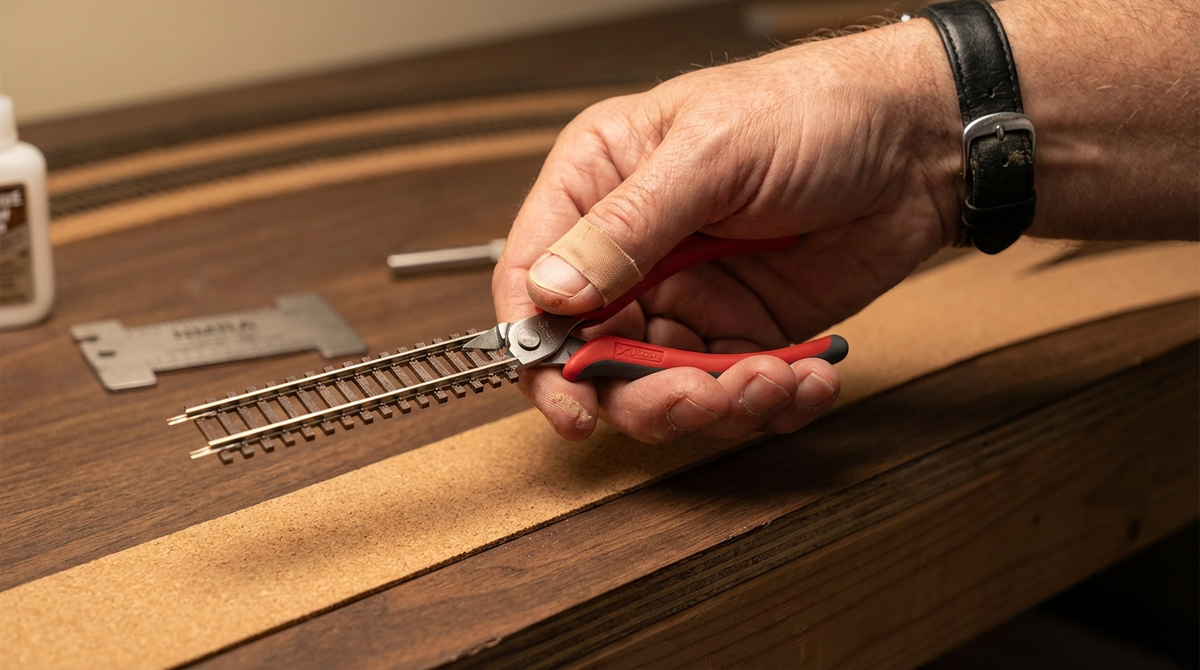
An NMRA standards gauge is the single most useful tool I own after my Xuron track cutters. It checks wheel gauge (the spacing between wheels on an axle), flange depth, and coupler height against published standards.
Out-of-gauge wheels are the leading cause of derailments at turnouts. A five-minute check with the gauge when you buy new rolling stock saves hours of frustration later.
When Bill started modeling, he drew track plans on graph paper. Today, software does the geometry for you.
XTrackCAD is free, open-source, and runs on Windows, Mac, and Linux. The learning curve is steeper than commercial alternatives, but the price is right.
AnyRail and SCARM offer more intuitive interfaces with free trial versions limited to 50-150 track pieces. Full licenses run about $60. Both include libraries of commercial track pieces that snap together on screen exactly as they do in real life.
The killer feature all these programs share: printing 1:1 scale templates. Tape the printout to your benchwork and lay track directly over it. No more measuring errors.
JMRI (Java Model Railroad Interface) is a free, open-source toolkit that every DCC user should know.
DecoderPro gives you a graphical interface for programming locomotive decoders. Instead of punching cryptic CV numbers into your throttle, you see labeled sliders and checkboxes for speed curves, sound volumes, and lighting effects.
PanelPro creates virtual control panels on your computer screen for operating turnouts and signals. WiThrottle and Engine Driver turn your smartphone into a wireless DCC throttle.
All free. All cross-platform. All maintained by volunteers who love this hobby.
I learned more in my first six months at our local NMRA division meetings than in the previous year of struggling alone. Watching someone demonstrate a technique beats reading about it every time.
The NMRA maintains a club directory searchable by location. NRail.org lists NTRAK and T-TRAK groups. Free-mo coordinates through Groups.io and Facebook communities.
Your local hobby shop knows who meets where. Mine closed five years ago, but while it lasted, it was the hub for everything happening in Worcester-area model railroading.
Every club operates differently, but some principles are universal.
Participate in setup and teardown. Everyone hauls modules, connects wiring, and breaks everything down at the end. The newcomer who shows up after setup and leaves before teardown won't stay welcome long.
Handle modules and equipment carefully. Never set drinks or tools on top of a module. Transport your own equipment securely.
Follow operating procedures. If the layout runs DCC, don't bring a DC locomotive. Learn how turnouts are controlled before touching anything. Ask questions. Experienced members genuinely enjoy teaching.
If you have outdoor space and dream of trains running through actual plants, garden railroading offers a distinct experience.
Track material becomes critical outdoors. Brass is most popular but oxidizes and requires regular cleaning. Stainless steel resists corrosion but costs more and conducts electricity less efficiently, requiring more feeders. Aluminum works only with battery power because its oxide layer kills electrical contact.
Roadbed construction for outdoor layouts means dealing with frost heave, drainage, and weed control. A concrete roadbed solves most problems permanently but requires significant upfront investment.
Many garden railroaders skip track power entirely. Battery power with radio control eliminates the constant track-cleaning battle that outdoor conditions demand. Any outdoor electrical installation needs GFCI protection for safety.
Plant selection for scale appearance is its own art. Dwarf conifers, creeping thyme, and miniature groundcovers maintain the illusion of scale while surviving real weather.
I've watched too many beginners stall because they tried to do everything at once. A structured approach works better.
Weeks 1-2 (Hours 1-20): Finalize your track plan in software. Build benchwork. Lay roadbed and track. Solder feeders to every rail section. Connect your DCC system and achieve that first train running. This is your foundation.
Weeks 3-4 (Hours 21-35): Wire turnouts. Test every inch of track for electrical reliability. Install backdrops. Apply base scenery coat.
Weeks 5-8 (Hours 36-60): Add basic ground cover. Install your first structure. Create car cards or switchlists for simple switching operations. The Inglenook Sidings puzzle teaches switching logic with minimal track.
Weeks 9-12 (Hours 61-100): Static grass application. Weathering practice on one freight car. Add details: figures, vehicles, signs. Host a mini operating session with a friend. Get feedback. Make a list of what to improve next.
By hour 100, you'll have a functional layout that runs reliably, looks presentable, and operates with purpose. That's when the real learning begins.
The NMRA publishes standards that ensure equipment from different manufacturers works together. Understanding three of them saves you from expensive mistakes.
RP-25 defines wheel contours for reliable operation on North American track. Most modern equipment conforms. Older models may have oversized flanges that catch on turnout frogs or won't fit in finer-scale track.
NEM 362 standardizes the coupler pocket on European models. If you buy a British or German locomotive and want to run it with American cars, you'll need to swap couplers. Kadee makes knuckle couplers with NEM-compatible shanks that drop directly into these pockets.
DCC decoder interfaces have proliferated confusingly. 8-pin NEM 652, 21-pin MTC, Next18, and PluX22 all describe different physical plugs. Check which interface your locomotive has before ordering a decoder, or you'll end up with hardware that doesn't fit.
The NMRA Beginner's Guide is free, comprehensive, and aligned with industry standards. Start there for foundational concepts.
The NMRA Achievement Program provides structured goals for skill development. The Golden Spike Award offers achievable milestones for your first layout: build 8 feet of track, three electrical components, five structures, and add scenery. It's a checklist that ensures you develop breadth across all aspects of the hobby.
Kalmbach Media publishes project-based books with complete instructions for building specific layouts. Following one step-by-step removes the paralysis of infinite choices.
Model Railroader magazine and its website offer tutorials, reviews, and inspiration. The NMRA education portal hosts clinic presentations from national conventions.
YouTube channels like Luke Towan and Chris Nevard demonstrate scenery techniques that simply don't translate well to printed instructions. Watching someone apply weathering powders teaches you more than any diagram.
Sixteen years ago, I inherited a half-finished layout and had no idea what I was doing. Today, my scratch-built New England depots have appeared in Model Railroader twice, and I've helped dozens of newcomers at our local club avoid the mistakes I made.
The hobby looks intimidating from the outside. So much equipment, so many techniques, so many opinions about the "right" way to do things.
But Bill figured it out before me, and I figured it out after him. The resources available today are better than anything we had. Start small. Build something that runs. Expand when you're ready.
That half-finished freight depot? It's been done for fifteen years now, sitting at the end of the siding where Bill planned to put it. Every time a train stops there to pick up a car, I think of him teaching me how to read the track diagram he'd sketched on a napkin.
Your railroad will have its own stories. Start building them.
✨ Complete Your Layout: Explore our wide selection of Photo Real buildings, diorama backdrops, detail parts, and accessories in every popular scale.
✨ Unmatched Realism: From chrome detailing products to neon lighting kits – every piece is designed to make your miniature world come alive.