
How to Build Realistic Model Train Mountain Scenery: A Forty-Year Modeler's Guide 2024 Edition
Posted by Harold Whitmore on 30th Nov 2025
Order by phone: 763-231-7847
Free Shipping On Orders Over $100!
If you are already registered, please log in.
Create your account and enjoy a new shopping experience.
Create A New AccountPosted by Harold Whitmore on 30th Nov 2025
Christmas morning, 1978. That's when I caught the bug. A Tyco freight set looping around a plywood oval in my father's basement, and suddenly I wasn't just a kid playing with trains. I was building worlds.
Forty-six years later, I still get that same electric feeling when I stand back from a finished mountain scene and watch a locomotive thread through the passes. But here's the thing: getting from "pile of foam" to "convincing Rocky Mountain diorama" isn't magic. It's method. And after three decades as a mechanical engineer and a lifetime at the workbench, I've learned what works, what fails, and what sends you back to square one with plaster dust in your hair.
Let me share what I know.
I've watched dozens of hobbyists grab a hot-wire cutter before they've sketched a single contour line. Don't be that person. The most realistic mountain scenery starts with research, not materials.
Pick a prototype. Are you modeling the sedimentary layers of the Colorado Rockies, the weathered granite of the Sierra Nevada, or the forested Appalachians? Each has distinct rock colors, strata angles, and vegetation patterns. When Sam Posey built his legendary Midland Central layout inspired by the Colorado Midland, his tilted rock strata sat at 50 degrees because that's what the actual geology dictates. That kind of specificity separates good scenery from great scenery.
Gather photographs. Haunt Google Earth. Visit the real location if you can. Your eyes will start picking up details you'd never imagine: the way talus piles at the base of cliffs, the color variation in exposed rock faces, how trees thin out approaching the treeline.
Here's where my engineering brain kicks in. Mountains aren't just visual; they're operational. Every tunnel, every bridge clearance, every grade affects whether your trains run smoothly or derail constantly.
The NMRA provides clearance standards for good reason. For modern-era HO scale (post-1983), a single-track tunnel portal needs to be at least 3.17 inches high and 2.20 inches wide. That's the minimum. I always add a quarter-inch buffer because today's double-stack containers and high-cube boxcars push those limits hard. Forum discussions on tunnel portal sizing consistently confirm that tight clearances cause the most frustrating re-work.
Grades matter too. While prototype railroads rarely exceed 2%, we can push to 4% in model form if we accept shorter trains and helper locomotives. Anything over 2% impacts locomotive performance noticeably. And don't forget vertical easements where grades change. Without them, your couplers will separate at the worst possible moment.
Track spacing on curves demands attention too. On an 18-inch radius curve, minimum HO double-track spacing increases to about 2.97 inches center-to-center to prevent sideswipes from equipment overhang.
Every mountain needs an armature, an internal structure that gives it shape and strength. I've built mountains using every method imaginable over four decades, and I'll tell you straight: extruded polystyrene foam (XPS) has earned its place as the dominant material for modern modelers.
Walk into any Home Depot and look for the pink or blue rigid foam insulation boards. That's FOAMULAR or similar XPS products. They're lightweight, moisture-resistant, dimensionally stable, and carve like butter.
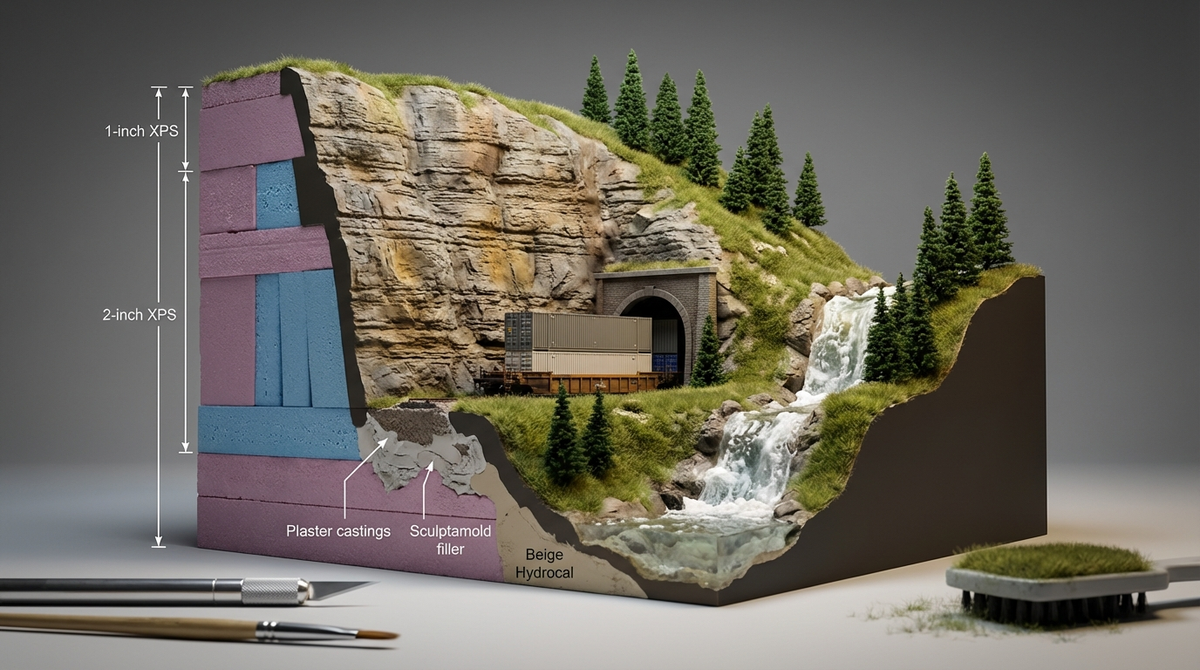
The typical modern workflow involves stacking 1-inch or 2-inch sheets to rough out your terrain contours, then carving and shaping them down. Doug Tagsold's famous Front Range scene used this exact method, stacking 2-inch extruded foam and securing the pieces with PL300 construction adhesive.
But here's where beginners trip up: adhesive selection. Use the wrong glue and you'll melt your foam into a sticky, shrunken mess. Solvent-based adhesives dissolve polystyrene on contact. Instead, reach for Liquid Nails for Projects (foam-safe formula), Loctite PL 300, or plain acrylic latex caulk. These create strong bonds without chemical damage.
For shaping, I use a combination of tools: a long-bladed utility knife for rough cuts, a Shurform rasp for smoothing slopes, and 40-grit sandpaper for final contours. Hot-wire cutters speed things up dramatically, though they require good ventilation (more on that in the safety section).
The traditional cardboard-web-and-plaster-cloth method still has its place. I use it for large, hollow sections that need to be removable or extremely lightweight.
The technique involves creating a lattice of interlocking cardboard strips, then covering it with plaster-impregnated gauze. Some modelers prefer cheesecloth over cardboard strips for more control. Either way, you get a rigid shell that's surprisingly strong.
The drawbacks? It's messier, requires longer drying times, and the finished shell is more brittle than foam. Beginners often struggle with getting enough layers for adequate thickness.
My recommendation: use a hybrid approach. Build your core from stacked XPS foam for speed and stability, then apply plaster cloth or Sculptamold only where you need fine rock detail.
Here's where artistry meets technique. Bad rock faces look like painted foam. Good rock faces make people lean in and squint, wondering if they're looking at a photograph.
For large rock formations, carving directly into the foam armature gives you the most control. After rough-shaping with a saw or knife, scrape the surface with a putty knife edge to create fractured, jagged textures. For sedimentary strata (layered rock), drag coarse sandpaper horizontally across the foam. A stiff wire brush creates the random crystalline texture of granite.
The key to hiding seams between foam pieces is feathering them with a flexible filler before painting.
Before any paint touches that foam, you need to seal it. The porous surface will absorb paint like a sponge otherwise. A thin layer of Sculptamold applied with a rubber spatula works beautifully. Drywall joint compound thinned with water is a cheaper alternative, though it can crack if applied too thick.
For the highest detail, nothing beats casting from rubber molds. Woodland Scenics and other manufacturers offer molds made from actual rocks, and the detail transfer is remarkable.
The casting material matters. Lightweight Hydrocal is my go-to for its low shrinkage and ability to capture fine detail. Plaster of Paris works but is more brittle. Mix to a soupy consistency, pour into a mold you've misted with "wet water" (water with a drop of dish soap), and tap the edges to release air bubbles.
Demolding takes about 30-40 minutes. Attach castings to your scenery base with foam-safe Liquid Nails or hot glue. The real challenge comes next: blending the seams.
Use Sculptamold or a similar flexible filler to feather the casting edges into the surrounding scenery. Work the filler while it's still wet, carving and texturing it to match the casting's pattern. This step separates amateur rockwork from professional results.
Monolithic, single-color rocks scream "fake." Real rock shows geological color variation, mineral deposits, weathering patterns, and shadow effects. The leopard-spot technique, developed by Dave Frary and adopted by Woodland Scenics, creates this variation through layered washes.
Start with a neutral tan or gray base coat. Then prepare two secondary color washes (Yellow Ocher, Stone Gray) at about 1 part pigment to 16 parts water. Dab these randomly over about two-thirds of the rock surface, letting them blend naturally.
Follow with a dark unifying wash (Raw Umber or Black) at an even weaker dilution, about 1 part pigment to 32 parts water. This settles into crevices and creates shadows. After drying, dry-brush the raised edges with a light gray to simulate where sunlight would strike.
For final weathering, an India ink wash (2 teaspoons of ink per 16 ounces of wet water) adds realistic grime and deepens shadows beautifully.
A mountain is more than rock. It's an ecosystem. Realistic ground cover gets built in layers, from soil to shrubs to tall grasses.
Your glue choice affects both appearance and longevity. Diluted white glue (1 part glue to 4 parts water) is cheap and works, but it stays water-soluble. Subsequent wet scenery applications can loosen earlier layers.
Matte medium is the superior choice for multi-layer work. It dries flexible, waterproof, and invisible. Once cured, it won't reactivate when you apply more wet scenery on top. I use a mix of 1 part matte medium to 3 parts wet water for most spraying applications.
Static grass creates the most realistic representation of wild vegetation, but it's also where many modelers hit frustration. The fibers won't stand up. They clump. They fall out.
Three factors cause most failures: poor electrical grounding (make sure the applicator's ground pin sits in the wet glue), high humidity (above 60% relative humidity kills static charge), and over-diluted adhesive. When your PVA-water mix exceeds 50% water, adhesion drops dramatically.
Build in layers for realism. Start with 2mm grass as your base. Once cured, add patches of 4mm and 6mm fibers using a dedicated layering spray adhesive. Longer 8-12mm fibers work sparingly for weeds and overgrown areas. Vacuum excess fibers after about 4 hours, not overnight, to prevent matting.
Foreground trees demand detail. Use armatures from natural twigs or commercial kits, apply quality foliage products, and vary species and sizes. Background forests can use simpler construction since viewers won't examine them closely.
A dense HO scale forest runs about 45 trees per square foot. Don't forget the understory: clumps of ground foam representing bushes, fallen logs (use actual twigs), and leaf litter scattered on the ground.
I've seen more scenery projects wrecked by water features than any other element. Leaks, cloudiness, and cracking frustrate even experienced modelers. But the techniques are manageable once you understand the failure modes.
Before any water product touches your layout, the basin must be completely sealed. No exceptions. Woodland Scenics provides detailed instructions for their products, and the principles apply universally.
Seal the base with multiple coats of paint or dedicated sealer. For open-ended features like rivers, create a temporary dam from styrene plastic sealed in place with silicone caulk. Then do a very thin initial pour (1/8 inch or less). This sealing layer finds and plugs any pinholes before your main pour.
Two-part epoxy (like Deep Pour Water) works best for deep water. It can be poured up to 1/2 inch thick and cures chemically with minimal shrinkage. The catch: it requires low humidity during curing to avoid "amine blush," a cloudy surface film.
One-part acrylics (like Realistic Water) cure by evaporation and suit shallow applications. Pour in thin layers (1/8 inch maximum) and let each cure completely before the next. They're prone to shrinkage and cracking if applied too thick.
Here's wisdom earned through painful experience: a mountain, once built, becomes an immovable obstacle to maintenance. Plan for access before you stack that first piece of foam.
No part of your track should be more than 18 inches from an edge. For deeper scenes, design removable mountain sections. This can be as simple as omitting glue between upper foam layers and using temporary finishing nails during construction. After scenery is complete, remove the nails, run a thin knife around the seam, and the top lifts off.
For hidden trackage inside mountains, build access hatches into the back or side of the scenery shell. Disguise them with dense foliage attached by magnets.
Great mountain scenery uses light and scale to create depth illusions. A single strong light source at about 30 degrees simulates natural sunlight and creates the shadows that define terrain contours. LED strips between 3500K and 4000K provide neutral midday light, while warmer temperatures suggest sunrise or sunset.
Forced perspective stretches the illusion of depth. Place smaller N-scale trees behind your HO foreground trees. Use finer-textured ground cover and less-saturated paint colors for distant hills. The backdrop should fade lighter and bluer toward the horizon, mimicking atmospheric haze.
I've attended too many clinics where safety gets a thirty-second mention. Let me be direct: scenery materials can harm you if mishandled.
Plaster, gypsum, and foam dust contain irritants. Wear a NIOSH-approved N95 or P100 respirator when cutting, sanding, or mixing these materials. A dust mask from the hardware store isn't enough.
Epoxy resins and solvent-based paints release volatile organic compounds. Work in well-ventilated areas and use a respirator with organic vapor cartridges. Isocyanate-containing products like certain urethane resins are particularly hazardous.
Hot-wire foam cutting releases styrene and other toxic fumes. Always use local exhaust ventilation, like a fan blowing fumes directly outdoors.
Foam manufacturers warn that XPS can show surface degradation after 90 days of sunlight exposure. Even indirect light through a basement window accumulates over years.
After painting, seal all scenery with UV-resistant matte varnish. Products with UVLS (Ultraviolet Light Stabilizers) extend your paintwork's life by years. The investment is minimal compared to repainting a faded mountain range.
Even after forty years, I still make mistakes. Here's how to recover from the common ones:
Melted foam: You used solvent-based adhesive or paint. Carve away the damaged section and patch with fresh foam or putty. Test any new product on scrap first.
Cracked plaster: Usually from too-wet mix, too-thick application, or substrate movement. Widen the crack into a V-shape with a hobby knife, fill with fresh plaster or flexible spackle, and re-texture while wet.
Visible rock casting seams: Fill with Sculptamold, carve and texture to match before it dries. Ground cover often hides minor seams acceptably.
Epoxy water leaks: Let it cure, then drain or remove the failed pour. Find the leak source, patch with epoxy putty, and re-seal the entire basin before trying again. The time loss hurts more than the material cost.
Static grass lying flat: Check your grounding, reduce humidity, and use proper adhesive concentration. Vacuum failed applications and retry with better technique.
Budget realism helps you plan. For a 2x4 foot mountain scene in HO, expect these ranges:
An economy build using recycled XPS, plaster cloth, and craft acrylics runs about $140-160 and 20-22 hours of work. You'll get decent results that look good from operating distance.
A midrange build adding a quality static grass applicator, Sculptamold, and commercial trees like SuperTrees runs $280-320 and 26-28 hours. The visual improvement over economy is dramatic.
A premium build incorporating precision hot-wire cutting, high-end static grass systems, epoxy water features, and UV-protective finishes pushes $500-550 and 34-36 hours. This is exhibition-quality scenery that stops viewers in their tracks.
The biggest budget drivers are tooling (static grass applicators, airbrushes) and vegetation quality. A good static grass applicator pays for itself in visual impact within a few square feet. Splurge on foreground trees and quality paints; save money on base materials.
After all the foam dust, dried plaster under your fingernails, and hours of painting tiny rock faces, there comes a moment. You step back. The layout lights come on. A locomotive rounds the curve, entering your mountain scene. And someone behind you says it:
"Wait... that's not real?"
That never gets old. Not after eight years old on Christmas morning with that Tyco set. Not after forty-six years of building worlds one layer at a time.
Now grab some foam. Let's build something together.
By Harold Whitmore, Train Modeler
Build Your Dream Railroad with Innovative Hobby Supply!
?️ Complete Your Layout: Explore our wide selection of Photo Real buildings, diorama backdrops, detail parts, and accessories in every popular scale.
✨ Unmatched Realism: From chrome detailing products to neon lighting kits – every piece is designed to make your miniature world come alive.