
HO Scale vs N Scale Which Is Better: A Practical Guide for Real Modelers
Posted by Tony Marchetti on 29th Dec 2025
Order by phone: 763-231-7847
Free Shipping On Orders Over $100!
If you are already registered, please log in.
Create your account and enjoy a new shopping experience.
Create A New AccountPosted by Tony Marchetti on 29th Dec 2025
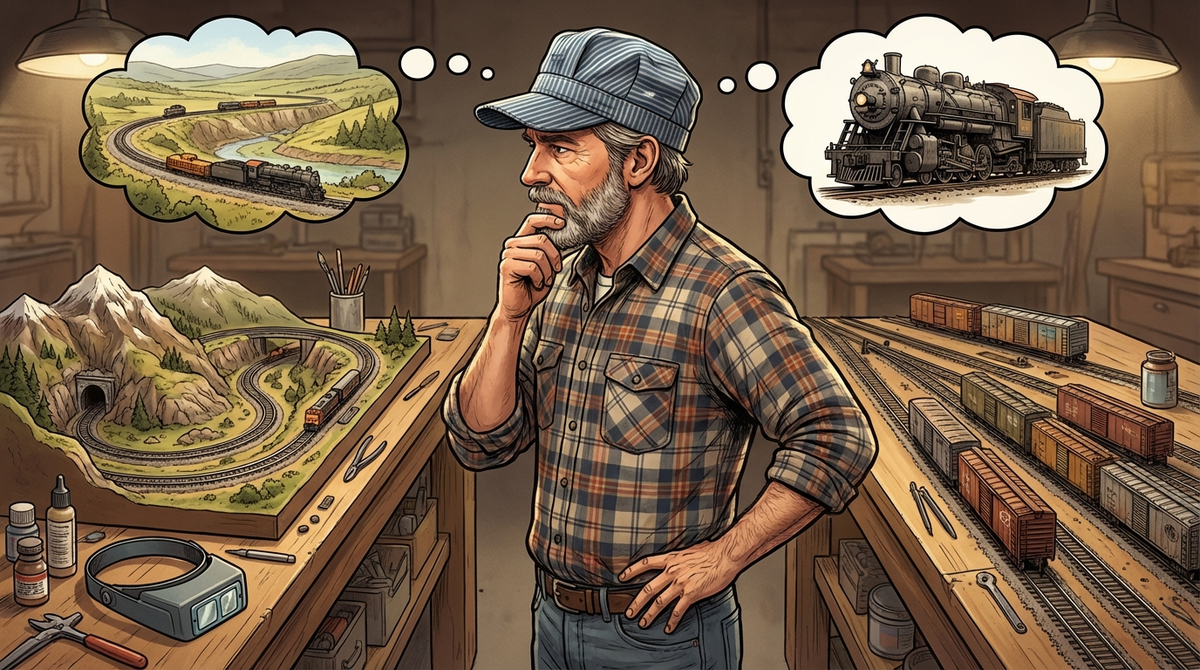
I've watched this debate rage in hobby shops and online forums for forty years, and I'm going to tell you something that might tick off the purists: there's no wrong answer here. HO scale and N scale are both legitimate choices, and anyone who tells you otherwise is selling something.
But that doesn't mean the choice doesn't matter. It matters a lot. The scale you pick will shape everything about your hobby experience for years, maybe decades. So let's cut through the noise and talk about what actually matters when you're deciding between these two popular scales.
Let's start with the elephant in the room. If you're working with limited space, N scale at 1:160 ratio gives you roughly eight times more scenic area than HO's 1:87 on the same footprint. That's not marketing fluff. That's geometry.
Take a standard 4x8 sheet of plywood. In HO, you're building a cramped oval with tight 18-inch radius curves that make your longest locomotives look like they're negotiating a parking garage. In N scale? You've got room for a real railroad. Multiple towns. Sweeping curves. Staging tracks. The works.
I've seen guys in studio apartments running impressive N scale layouts that put some basement empires to shame. If you're renting, if your spouse has opinions about how much house the trains get, or if you just don't have a spare room to dedicate, N scale lets you build something meaningful in a space HO can barely function in.
Here's where things get practical. In HO, an 18-inch radius is considered minimum, and honestly, it looks terrible for anything longer than a 50-foot boxcar. You really want 22 inches minimum for decent operation, and 30 inches or more if you're running modern six-axle power or long passenger cars.
In N scale, a 9.75-inch radius works for basic stuff, but 11 to 12 inches is the practical minimum. Jump to 15-18 inches and you can run anything made, including those beautiful autoracks and full-length passenger consists.
The math works out nicely: you can fit 18-inch N scale curves in the same space that would only allow cramped 18-inch HO curves. But the N scale curves are prototypically broad for that scale, while the HO curves look like a carnival ride.
For decades, the standard advice was simple: if you want to do serious super-detailing, go HO. The larger models give you more surface area to work with, and the parts are big enough to handle without a microscope.
That advice isn't wrong, exactly. It's just less right than it used to be.
The game-changer is high-resolution resin 3D printing. We're talking about machines that can resolve details down to 0.0285mm. That's fine enough to print legible signage and scale grab irons in N scale that would have been impossible five years ago.
I've seen modelers printing custom parts that rival the best commercial offerings. The cottage industry of 3D-printed detail parts is exploding, and N scale modelers are the biggest beneficiaries because they needed it most.
Here's where I have to be honest with you. In HO, you're typically using .012 to .015 inch wire for handrails, which is manageable for most people. In N scale, you're down to .007 to .008 inch wire. That's hair-thin. It takes steady hands, good magnification, and patience.
The modelers doing detailed N scale work with handmade grab irons are performing minor miracles. It can be done, and it looks stunning when it's done right. But you're working at the edge of what human fingers can handle.
For weathering and finishing, the larger HO surfaces are more forgiving. You can lay on a wash or hit it with an airbrush without worrying that you've just obscured all the details you worked so hard to add. In N, a light touch is mandatory.
This is where the story has changed most dramatically in the past decade. The old knock on N scale was reliability. Smaller wheels meant worse electrical pickup. Lighter locomotives stalled on dirty track. Sound was tinny or nonexistent.
Not anymore.
Modern ESU LokSound 5 Micro decoders measure just 21mm x 10mm and deliver premium 16-bit sound with sophisticated motor control. The LokSound 5 Nano is even smaller at 19.6mm x 8.5mm. These aren't compromised versions of full-sized decoders; they're legitimate high-performance units that happen to fit in tiny shells.
The Next18 interface standard has made drop-in installations possible for many N scale locomotives. Gone are the days when installing a decoder meant twenty hours of surgery with a soldering iron and a prayer.
| Decoder | Scale Focus | Dimensions | Audio Power |
|---|---|---|---|
| ESU LokSound 5 | HO/O | 30 x 15.5mm | 3W |
| SoundTraxx TSU-2200 | HO/O | 35 x 18mm | 2W |
| ESU LokSound 5 Micro | N/small HO | 21 x 10mm | 3W |
| SoundTraxx TSU-1100 | N/small HO | 27 x 10.5mm | 1W |
| ESU LokSound 5 Nano | N/Z | 19.6 x 8.5mm | 3W |
The real revolution is the compact keep-alive capacitor. Products like the ESU PowerPack store enough juice to carry a locomotive through dirty track spots and insulated frog turnouts without missing a beat.
A 2024 Free-moN study reported 60% fewer locomotive stalls after mandating keep-alives on powered-frog turnouts. That's the difference between a frustrating operating session and a smooth one.
The operational playing field between HO and N scale has leveled. If you install a good decoder with a keep-alive, both scales can deliver rock-solid performance.
I won't lie to you here. Bigger speakers make better sound, especially in the low frequencies that give diesel rumbles and steam chuffs their weight. An HO locomotive can fit a 28mm speaker in a proper enclosure. An N scale locomotive is limited to tiny sugar cube speakers that struggle with bass.
The quality gap has narrowed with better speaker technology and psychoacoustic tricks in the decoders, but an HO sound locomotive still sounds fuller. If authentic sound is your priority, score one for HO.
Let me give you the straight numbers. HO scale dominates the market with roughly 65-78% share in North America and Europe. A search of a major distributor shows about 47,000 HO SKUs versus 11,000 for N scale. If you want it, someone makes it in HO.
That breadth matters if you model obscure prototypes or specific eras. Looking for a Reading T-1 in HO? Multiple options. In N? Good luck.
But here's what the raw numbers don't show: N scale product announcements are growing at about 10% per year, compared to 2% for HO. The major players are taking N seriously.
Broadway Limited now offers their Paragon4 sound in N scale. ScaleTrains' Rivet Counter line releases parallel toolings in both scales. Rapido Trains brings the same obsessive accuracy to N that made their HO products famous. Athearn's Genesis line serves both scales with high-detail models.
The Kato ecosystem is particularly strong for N scale, with their Unitrack system being a favorite for its reliability and the smooth runners they're known for. In Japan, N scale is actually the dominant choice because of space constraints in homes, and companies like Tomix offer massive catalogs.
In HO, Kadee Magne-Matic couplers are the de facto standard. They work. They're reliable. Everybody uses them or something compatible with them.
In N scale, Micro-Trains couplers fill the same role. A common upgrade is converting from truck-mounted to body-mounted couplers for better appearance and reliability. Some modelers even use Z scale couplers for even more realistic proportions.
Either scale gives you a reliable ecosystem once you standardize on quality couplers.
People always ask me which scale is cheaper. The honest answer is: it depends on what you're building.
Individual N scale locomotives and rolling stock are often similarly priced or slightly cheaper than HO equivalents. A high-end sound locomotive in either scale will set you back $300-400. Basic freight cars run $15-30 in both scales from quality manufacturers.
Starter sets from Bachmann or Kato are under $250 in both scales. Entry-level DCC systems like the NCE Power Cab or Digitrax Zephyr Express run $200-300 and work fine for either scale.
Here's where the scales diverge. An equivalent operational scheme in HO requires more track, more benchwork lumber, more scenery materials, and more structures. I've seen estimates of 18-27% higher material costs for HO when you're building comparable layouts.
On the flip side, HO's larger and more mature secondary market can cut rolling stock acquisition costs by 30% if you're willing to buy used. More HO stuff has been made over more decades, so there's just more of it floating around at train shows and on eBay.
Budget-conscious modelers with workshop space may find HO's higher material costs offset by used equipment savings. Space-limited modelers often save 20% or more by choosing N scale and building smaller.
Here's where I get personal, because this is the stuff that actually affects whether you stay in the hobby or drift away.
N scale parts are small. Really small. Working with them requires good close-up vision and steady hands. Many N scale modelers work with OptiVISOR magnifiers as standard equipment.
I've talked to modelers who switched from N to HO specifically because their eyesight or dexterity wasn't what it used to be. A 2024 NMRA survey showed 22% attrition among N scale modelers over 60, compared to just 8% in HO, with most citing vision and dexterity issues.
HO's larger components are easier to see, handle, and work with. Rerailing a car, adjusting a coupler, or soldering a decoder is more forgiving when everything is twice the size.
Some things don't change with scale. Aisle widths need to be 24 inches minimum, but 30-36 inches is much more comfortable. Reach-in depth should stay under 24-30 inches to avoid back strain and accidental damage. These constraints apply whether you're running N or HO because you, the operator, don't scale down.
N scale modelers often prefer higher layout heights (50-54 inches) to bring the smaller details closer to eye level. HO modelers can work with slightly lower heights (40-48 inches) and still see everything clearly.
If young children will be involved, HO scale's larger size and more robust construction handles rough handling better. N scale models are delicate and can be easily damaged by enthusiastic young operators. They also present a choking hazard for very young kids.
For family-oriented layouts, HO is usually the safer bet.
Both scales can deliver excellent operational performance, but they face different challenges.
The physics of pulling trains up grades is scale-neutral: moving weight uphill requires force. A typical HO locomotive might pull 15-20 cars up a 2% grade. N scale locomotives, being lighter with smaller motors, pull proportionally smaller trains.
The John Allen formula for calculating effective grade on curves shows that N scale actually benefits from being able to fit broader curves: a 2% grade on a 22-inch radius in N scale feels like about 2.73% effective grade, while a 2% grade on an 18-inch radius in HO feels like 3.78%.
Drawbar pull measurements confirm what physics predicts: HO locomotives, with more mass and larger motors, produce more absolute pulling power. But N scale locomotives pulling N scale equipment on N scale grades work just fine if you tune everything properly.
Reliable operation in either scale requires attention to detail:
The decoder installation guide from SoundTraxx covers the electrical side for both scales.
If you want to participate in club layouts or public shows, modular standards matter.
Free-mo for HO and Free-moN for N scale emphasize prototypical operations with high standards for trackwork and scenery. The Free-mo standard specifies Code 83 rail for HO, while Free-moN uses Code 55 nickel-silver. Both focus on realistic, plausible modeling rather than just running trains in circles.
NTRAK is a long-standing N scale standard based on 2'x4' modules with three parallel tracks. It's club-oriented and accessible, though less focused on point-to-point operations.
T-TRAK is the most portable standard, using small modules based on Kato Unitrack that set up on banquet tables. Its simplicity has made it popular worldwide, especially for apartment dwellers.
Looking at trends through 2030, several factors will continue shifting the landscape.
High-resolution 3D printing will only get better and cheaper. The detail gap between scales will continue shrinking as modelers gain access to tools that can produce injection-molding quality at home.
Decoder miniaturization will continue benefiting N scale. Expect more integrated keep-alives and better micro-speakers. Wireless throttle apps and Wi-Fi hardware like the TCS UWT-100 are becoming standard, freeing operators to move around larger layouts in either scale.
The DCC-EX open-source platform is making advanced automation accessible to more hobbyists, potentially including AI-powered dispatching for complex operating sessions.
N scale product announcements continue outpacing HO growth rates. As more manufacturers invest in parallel toolings, the availability gap will narrow. Five years from now, choosing between scales will be even more about personal preference and less about which scale has the equipment you need.
After all that, here's my practical advice:
Choose N scale if:
Choose HO scale if:
The NMRA's beginner resources can help you think through the decision, but the best advice is to actually handle some models in both scales before committing. Go to a train show or visit a good hobby shop. See what feels right in your hands and looks right to your eyes.
Both HO and N scale can deliver a lifetime of satisfaction. The right choice is the one that fits your space, your skills, and your vision for the railroad you want to build.
By Tony MarchettiBuild Your Dream Railroad with Innovative Hobby Supply!
?️ Complete Your Layout: Explore our wide selection of Photo Real buildings, diorama backdrops, detail parts, and accessories in every popular scale.
✨ Unmatched Realism: From chrome detailing products to neon lighting kits – every piece is designed to make your miniature world come alive.