
HO Scale Train Set for Adults: The 2025 Buyer's Playbook for Building a Real Railroad
Posted by Benjamin Park on 29th Dec 2025
Order by phone: 763-231-7847
Free Shipping On Orders Over $100!
If you are already registered, please log in.
Create your account and enjoy a new shopping experience.
Create A New AccountPosted by Benjamin Park on 29th Dec 2025
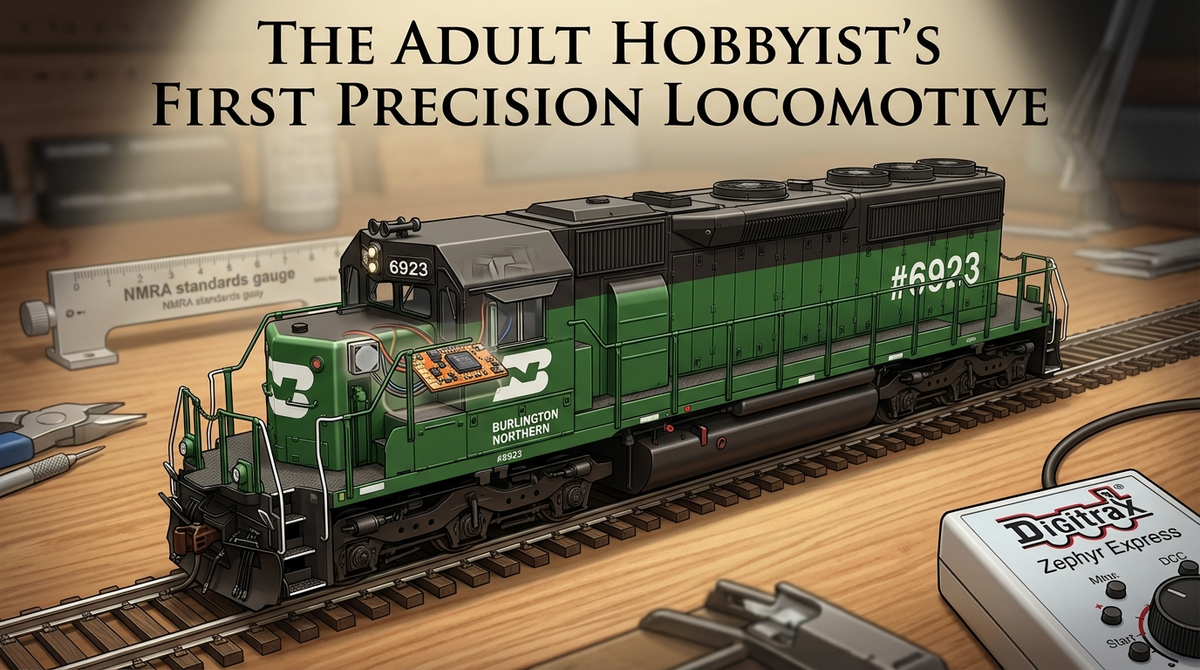
I got back into model railroading because I thought it would be relaxing. After twenty years managing freight logistics, I figured pushing tiny trains around a basement would be the perfect antidote to pushing real ones across spreadsheets. Then I discovered prototype operations, and now my Saturday night sessions with timetables and train orders are arguably more stressful than my day job.
But here's what I've learned: the difference between a frustrating hobby and a rewarding one often comes down to what you buy in the first few months. And if you're an adult looking at an HO scale train set for adults, you're already making the right call on scale. Now let's make sure you don't waste money on gear you'll replace in six months.
The global model train market hit $3.5 billion in 2024 and is projected to reach $5.8 billion by 2033. HO scale captures roughly 65% of that adult hobbyist market, and for good reason.
At 1:87 scale, HO hits a sweet spot that N scale and O scale can't match. The models are large enough to show off fine details you can actually see without a magnifying glass, yet small enough that you can build a meaningful layout in a spare bedroom or garage. A basic HO layout can start on a 4x6 foot table, with 4x8 being ideal for expansion.
The real advantage? Over 40 manufacturers produce HO equipment, which means competitive pricing and an absurd variety of locomotives, rolling stock, and structures for every era and prototype imaginable. Whether you're modeling 1940s steam or modern intermodal, someone makes what you need.
Here's what's changed: the hobby is getting older and richer. The average NMRA member is over 60, but there's a growing cohort of serious hobbyists in the 30-60 range with disposable income and zero patience for toy-grade junk. We want prototype accuracy, factory-installed DCC and sound, and operational realism.
Manufacturers have noticed. The days of simple kit-building are giving way to sophisticated, ready-to-run models with advanced electronics and artistic detail that would have been unthinkable twenty years ago.
Let's kill a misconception right now: for serious hobbyists, a "train set" isn't a loop of track with a plastic locomotive. It's the foundation of a working model railroad. The difference between toy-grade and adult-grade comes down to specific technical standards.
| Feature | Toy-Grade | Adult-Grade | Why It Matters |
|---|---|---|---|
| Control System | Basic DC power pack | DCC-Equipped or DCC-Ready | Independent control of multiple trains, lights, and sound |
| Track | Steel or brass rails | Nickel-Silver (Code 83/100) | Resists corrosion, better electrical contact for DCC |
| Wheelsets | Plastic, oversized flanges | Metal with NMRA RP-25 contour | Cleaner tracking, better pickup, fewer derailments |
| Couplers | Horn-hook or oversized knuckle | Kadee-compatible knuckle | Reliable hands-free operation, realistic switching |
| Locomotive Drive | 3-pole motor, plastic gears | 5-pole skew-wound motor with flywheels | Smooth slow-speed performance, consistent speed under load |
| Car Weight | Often underweight | Weighted to NMRA RP-20.1 | Prevents derailments and string-lining on curves |
The NMRA recommendation for car weight is 1 ounce plus 0.5 ounce per inch of car length. A 40-foot boxcar (about 6 inches in HO) should weigh around 4 ounces. Most toy-grade cars weigh half that, which is why they derail constantly.
Three brands dominate the adult starter set market, each with distinct philosophies and trade-offs.
Bachmann owns the starter set market with products like the Echo Valley Express ($499 MSRP, street price around $355). The E-Z Command Plus controller supports up to 29 functions and 128 speed steps, which sounds great on paper.
The problem? Forum discussions reveal that nearly half of users report operational issues like derailments, usually traced to lower-quality plastic wheels and truck-mounted couplers. The E-Z Track system uses integrated roadbed that limits scenery options and may not be as electrically reliable over time.
If you go Bachmann, budget an immediate $60 for Kadee couplers and InterMountain metal wheelsets. Consider it the cost of admission to reliable operation.
Walthers Trainline sets like the Flyer Express ($180-$240) come with superior components out of the box: metal wheels, Proto MAX knuckle couplers, and decent rolling stock. The locomotive is a GP15-1 diesel that runs well.
The catch is these sets ship with basic DC controllers. You'll need to buy a DCC system separately. For builders who want to choose their own command station anyway, Walthers offers a better starting point than Bachmann's compromised DCC package.
Kato's reputation for bulletproof reliability extends to their HO offerings. The Amtrak P42 Starter Set ($599 MSRP, street ~$440-$485) includes a high-quality P42 locomotive with a coreless motor, three passenger cars, and a generous oval of Code 83 nickel-silver Unitrack.
Kato Unitrack is widely regarded as the best sectional track system available. The UniJoiner connections are secure, it's DCC-friendly, and it looks realistic. The set ships with DC, but the track and locomotive are ready for a seamless DCC transition.
For serious adult hobbyists, the Kato set offers the best long-term value despite the higher upfront cost. You're not paying to replace frustrating components within months.
Digital Command Control isn't optional anymore. Every premium locomotive from brands like Rapido, Athearn Genesis, and WalthersProto ships with factory-installed decoders. The question isn't whether to go DCC, but which system to buy.
| System | Power Output | Street Price | Best For |
|---|---|---|---|
| Digitrax Zephyr Express | 3.0 Amps | $185-$240 | Expandable layouts, club compatibility |
| NCE Power Cab | 2.0 Amps | $195-$250 | Small layouts, single operators |
| ESU CabControl | 7.0 Amps | $550+ | Wireless-first, smartphone control |
| MRC Prodigy Express² | 1.6 Amps | ~$165 | Budget-conscious beginners |
If you're building a small shelf layout or switching pike, the NCE Power Cab does everything you need. Its 2.0 amp output handles 3-4 sound-equipped locomotives, and the handheld design is intuitive. Many operators swear by its simplicity.
If you envision future expansion, operating sessions with friends, or joining a modular club, the Digitrax Zephyr Express is the strategic choice. Its LocoNet bus offers near-limitless expansion with throttles, detectors, and components from multiple manufacturers. The built-in USB interface provides seamless JMRI integration without additional hardware.
If wireless control and modern interfaces are your priority, ESU CabControl delivers a premium experience with built-in Wi-Fi and high-resolution wireless throttles. The 7.0 amp booster handles large layouts, and native RailComPlus support allows automatic registration of compatible ESU decoders.
The track included in starter sets is where manufacturers cut costs. Upgrading early saves frustration and avoids labor-intensive rewiring later.
All reputable track for adult hobbyists uses nickel-silver rail. It conducts electricity better than brass and resists the corrosion that creates dead spots on older layouts. Steel rail rusts. Brass oxidizes into an insulating layer. Nickel-silver just works.
Code 100 (.100" rail height) is common, but Code 83 (.083" height) has become the standard for serious modelers. The finer rail looks more prototypical with smaller ties and spikes. Most modern equipment runs fine on Code 83, and the visual improvement is worth the slightly higher cost.
Turnouts (switches) cause more operational failures than any other component. Cheap turnouts derail trains and create electrical dead spots that stall DCC locomotives.
The problem centers on the frog, where rails cross. Unpowered plastic frogs create a dead spot that can stall locomotives with short wheelbases or poor pickup. Modern, high-quality turnouts solve this with powered metal frogs.
Peco Unifrog turnouts represent the current state-of-the-art. They function as DCC-friendly turnouts out of the box, with easy options to power the frog using a switch machine or frog juicer. The result is maximum electrical reliability with minimal wiring complexity.
For mainlines, use No. 6 turnouts minimum for smooth operation. Larger numbers (No. 8) are better for high-speed running. No. 4 and No. 5 turnouts work for space-constrained yards but may limit which locomotives you can use.
The equipment you run dictates your track geometry. Violating minimum radius leads to derailments and destroyed detail parts.
| Equipment Type | Minimum Radius | Recommended |
|---|---|---|
| 4-Axle Diesels (GP38, SW1500) | 18" | 22" |
| 6-Axle Diesels (SD40-2, SD70ACe) | 22" | 24-28" |
| Large Steam (4-8-4, 2-10-2) | 24-28" | 30-32" |
| 85'+ Passenger Cars | 24" | 28-32" |
| 89' Flat Cars / Autoracks | 24-30" | 32" |
Reliable DCC operation depends on solid bus wiring, not rail joiners.
Once wiring is complete, perform the quarter test: place a coin across the rails at various points. Your DCC system's circuit breaker should trip instantly. If it doesn't, your wiring has too much resistance, creating a fire hazard and risking decoder damage during shorts.
Your first six months should focus on three upgrades that yield the highest return on operational reliability.
Plastic wheels accumulate dirt, increase rolling resistance, and have oversized flanges that cause derailments on finer-scale track.
Replace all wheelsets with metal ones conforming to NMRA RP-25 wheel contour. InterMountain wheelsets are top-of-the-line, featuring non-magnetic blackened metal and precise axle lengths. Kadee and WalthersProto also make excellent options.
Use 33" diameter wheels for most freight cars (50-70 ton capacity) and 36" wheels for modern 100-ton cars and all passenger cars. Use an NMRA Standards Gauge to verify back-to-back spacing is correct.
Inconsistent couplers cause unwanted uncoupling and operational failures. Pick one system and stick with it.
Kadee Magne-Matic couplers are the industry benchmark. The #148 "Whisker" coupler is a drop-in replacement for plastic knuckles on most ready-to-run models. For more prototypical appearance, the #158 "Scale Head" Whisker offers a smaller profile, though it's less forgiving on imperfect track.
Use a Kadee #206 Coupler Height Gauge to set every coupler to the NMRA standard height of 25/64" above the railhead. This single step eliminates most coupling failures.
Even with clean track, momentary power interruptions at turnout frogs or dirty spots cause sound decoders to reset and locomotives to stall. Keep-alive capacitors solve this by providing a brief power reserve.
A small TCS KA2 or KA3 provides 5-8 seconds of power, more than enough to glide over any typical dead spot. SoundTraxx CurrentKeeper and ESU PowerPack offer similar solutions.
Installation requires soldering two wires to the decoder's designated pads. Do this before weathering or detailing the locomotive, while it's still easy to disassemble.
| Upgrade | Cost per Car/Loco | Impact |
|---|---|---|
| Metal Wheelsets | $3.00-$4.50 | Reduces dirt buildup, improves tracking |
| Kadee Couplers | $2.50-$3.00 | Eliminates random uncoupling |
| Keep-Alive | $15.00-$25.00 | Ends sound dropouts and stalling |
Once your fleet runs reliably, focus on performance and realism.
Factory sound is often basic. Upgrading to ESU LokSound 5, SoundTraxx Tsunami2, or TCS WOWSound delivers dramatically better audio and motor control.
Modern DCC-ready locomotives use standardized sockets like 21-MTC (NEM660) or PluX22, making installation plug-and-play. Older DC models require hardwiring, which demands soldering skills and motor isolation.
Premium decoders offer superior Back-EMF motor control for exceptionally smooth slow-speed performance. Tuning BEMF settings is a key step in optimizing a locomotive's operation.
The speaker matters as much as the decoder. Factory speakers are compromises.
"Sugar cube" speakers (11x15mm) have become standard, offering impressive sound from compact footprints. But a speaker without a sealed enclosure produces thin, tinny audio. The enclosure allows proper resonance and richer bass.
To eliminate the last dead spots, power your turnout frogs. Use a frog juicer (automatic polarity switch) or wire the frog to auxiliary contacts on a slow-motion switch machine like a Tortoise by Circuitron. This ensures the frog always has correct polarity for stall-free operation.
Budgets vary wildly based on quality expectations. Here's what three years realistically looks like at different tiers.
Navigating the purchasing landscape in 2025 requires understanding how different retailers operate.
Walthers has a 30-60 day return window with potential 20% restocking fees. Lombard Hobbies doesn't accept returns on DCC or electronics. Brady's Trains charges a 15% restocking fee and requires non-refundable deposits on preorders.
Old Engine House offers zero-deposit preorders with flexibility if delays become excessive. For must-have limited runs, this is where I place my orders.
For limited-run models from Rapido, ScaleTrains, and Athearn Genesis, preordering is no longer optional. Many sell out months before arrival.
Tariffs on Chinese imports (20%) are creating price volatility. Manufacturers have responded by either adding tariffs as line items or raising MSRPs 8-12%. Expect further increases.
Buy from authorized dealers listed on manufacturer websites or reputable long-standing retailers. On eBay and Facebook Marketplace, always use PayPal Goods & Services. Never use Friends & Family for purchases.
The used market offers 33% or more savings below MSRP, but success requires discipline.
Train shows and swap meets allow in-person inspection. Trainz.com and Model Train Market have reputable used sections. Hobby shop consignments and specialized forums like TheRailwire are excellent sources.
On eBay, be wary of vague descriptions, stock photos, and "as-is" listings. AI-generated descriptions often lack specific condition details.
Steer clear of "train set quality" models, older Bachmann rolling stock, and brands known for non-standard components (Life-Like, Tyco). These require more effort to upgrade than they're worth.
The last decade has transformed what "adult-grade" means in HO scale.
2015: Broadway Limited's Paragon3 set new standards for factory sound with Rolling Thunder subwoofer integration.
2016-2017: ScaleTrains.com launched, introducing the "Rivet Counter" line with factory-installed ESU LokSound decoders.
2018-2019: Peco introduced Unifrog turnouts, combining the benefits of Insulfrog and Electrofrog designs.
2019-2021: TCS released Wi-Fi throttles. ESU launched CabControl for the North American market. BLI introduced Paragon4 with built-in keep-alive capacitors.
2022-2024: SoundTraxx released Blunami decoders, enabling direct Bluetooth control from smartphones without traditional DCC systems.
Battery-on-board ("Dead Rail") technology will continue advancing, eliminating track pickup issues entirely. 3D scanning for body shells (pioneered by Rapido) will become standard. Expect increased focus on spare parts availability and repair services as premium model prices rise.
The fastest way to flatten your learning curve is engaging with people who've already made your mistakes.
Look for disclosures of manufacturer relationships. O Scale Trains Magazine explicitly separates editorial from advertising. Be skeptical of YouTube channels without sponsorship disclosures.
The best reviews compare models directly to prototypes. Magazine reviews have historically provided speed curves and measurements, though some readers feel recent coverage is less critical.
A single review is a data point. Community consensus across multiple forums is a finding.
Join your local NMRA division and attend a meet. Read the NMRA Beginner's Guide. Hands-on engagement beats passive reading every time.
An HO scale train set for adults isn't about buying a box of nostalgia. It's about building infrastructure for a hobby that can last decades.
Start with quality where it matters: DCC-friendly track, a capable command station, and locomotives that run reliably out of the box. Budget for immediate upgrades to wheels and couplers on cheaper rolling stock. Learn to solder and install keep-alives before you need them.
The hobby rewards patience. My Milwaukee Road layout took two years before I ran my first timetable session, and I'm still upgrading turnouts I should have bought right the first time. But when that first scheduled meet with a friend ended with trains arriving on time and freight cars spotted at the correct industries, I understood why people stick with this for life.
It's not relaxing. It's better than that.
By Benjamin ParkBuild Your Dream Railroad with Innovative Hobby Supply!
?️ Complete Your Layout: Explore our wide selection of Photo Real buildings, diorama backdrops, detail parts, and accessories in every popular scale.
✨ Unmatched Realism: From chrome detailing products to neon lighting kits – every piece is designed to make your miniature world come alive.