
HO Scale Minimum Curve Radius: What Actually Works vs. What the Box Claims
Posted by Harold Lindgren on 29th Dec 2025
Order by phone: 763-231-7847
Free Shipping On Orders Over $100!
If you are already registered, please log in.
Create your account and enjoy a new shopping experience.
Create A New AccountPosted by Harold Lindgren on 29th Dec 2025
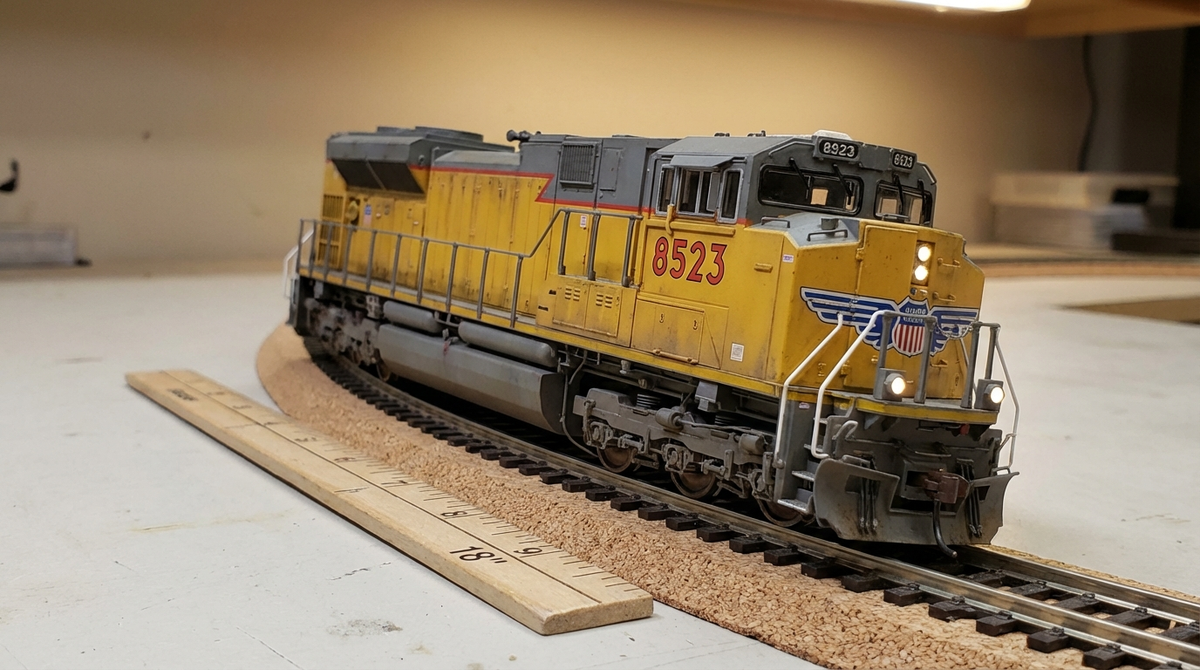
I've built four HO layouts since retiring from the construction business, and every single one taught me the same painful lesson: the curve radius printed on your locomotive box is about as reliable as a contractor's estimate on a bathroom remodel. That 18-inch minimum they claim? It's technically true in the same way that you can fit a king-size mattress through a standard doorway. You might get it done, but you're going to hate the process.
After forty years of building houses and six years of building layouts, I've learned that cutting corners on curves is the fastest way to turn your dream railroad into a frustration machine. So let me walk you through what I've learned about HO scale minimum curve radius from actual experience, not marketing copy.
Here's the uncomfortable truth that nobody at the hobby shop wants to tell you: the 18-inch radius curve was designed for an era when HO models were shorter, simpler, and frankly, a lot less prototypical. Today's premium models from ScaleTrains and Athearn Genesis still print "18-inch minimum" on the spec sheet, but extensive testing by modelers reveals a different story: frequent derailments and severe, unrealistic overhang on anything under 22 to 24 inches.
Model railroad clubs I've visited report rework rates as high as 40% on layouts built to the old 18-inch standard. That's not a minor inconvenience. That's tearing up track and starting over because you trusted the manufacturer's most optimistic specifications.
Think of 18-inch curves the way you'd think of the minimum lot setback in building codes: legal, sure, but build right to that line and you'll regret it every time you look out the window. Reserve those tight curves for hidden staging tracks or cramped industrial spurs where operational reliability matters more than appearance. For anything you actually want to watch, plan for 24 inches or greater.
Most modelers blame locomotives when things go wrong on curves. Makes sense on the surface, right? Big engine, long wheelbase, tight curve, problem. But in my experience, the real culprit is usually sitting three cars back in your train.
A large 2-10-2 steam locomotive can often negotiate a 28-inch curve thanks to design tricks like blind (flangeless) center drivers. Meanwhile, a single 85-foot Walthers passenger car with body-mounted couplers needs a 30-inch radius for those couplers to swing without binding.
The most reliable planning formula I've found is simple: use 3x the length of your longest piece of equipment as your minimum radius. Running 85-foot passenger cars that measure about 12 inches in HO? You need at least 36 inches of radius for them to look right and run reliably. That's not me being fussy. That's just geometry doing what geometry does.
On a curve, two things happen that will ruin your day. First, the center of a long car hangs inside the track centerline while the ends swing outward. This "overhang" gets dramatically worse as radius decreases. Second, tight curves add frictional resistance equivalent to climbing a grade. Your locomotives work harder, and lighter cars in the middle of your train start getting pulled toward the inside of the curve in a phenomenon called "stringlining."
I watched this happen in real time at a friend's layout. He was running a nice 20-car mixed freight with an Athearn Genesis SD70ACe. Looked great on the straightaways. Hit the 20-inch curve into the tunnel, and cars 8, 9, and 10 yanked themselves right off the track. The locomotive had the power. The track was fine. The physics just didn't care.
Rather than repeating the same generic advice you've read everywhere else, let me give you specific numbers based on actual equipment performance. These come from manufacturer specs, NMRA standards, and hard-won experience from club layouts and my own basement.
This is the forgiving category. Your 40-foot boxcars, covered hoppers, and tank cars will happily run on 18-inch curves all day long. They'll even look reasonably good doing it. Bump up to 50-foot cars and you'll start noticing overhang, but they'll still operate reliably at 18 inches if your track is well-laid.
| Equipment Type | Absolute Minimum | Recommended | Looks Good At |
|---|---|---|---|
| 40' Box/Hopper | 16" | 18" | 22"+ |
| 50' Box/Flat | 18" | 22" | 24"+ |
| 60' Gondola | 18" | 22" | 26"+ |
This is where the 18-inch standard completely falls apart. Modern autoracks from ScaleTrains and 89-foot flatcars from Athearn will technically navigate 22-inch curves, but they look terrible doing it. The overhang is severe enough that passing trains on parallel tracks will collide unless you dramatically increase your track spacing.
| Equipment Type | Absolute Minimum | Recommended | Looks Good At |
|---|---|---|---|
| 73' Centerbeam | 22" | 26" | 32"+ |
| 86' Hi-Cube Boxcar | 24-28" | 30" | 36"+ |
| 89' Flat/TOFC | 22-24" | 30" | 36"+ |
| 89' Autoracks | 22-24" | 28-30" | 40"+ |
Four-axle diesels like Geeps and RS-series road switchers are your best friends on smaller layouts. Most are genuinely designed for 18-inch curves and will perform reliably there. Athearn's GP38-2 is a good example of a model that genuinely works at its stated minimum.
Six-axle diesels are trickier. ScaleTrains and Athearn both list 18-inch minimums for their modern six-axle units, but every experienced modeler I know recommends 22 inches as the practical floor. The overhang on an SD70ACe rounding an 18-inch curve looks like a drunk trying to parallel park.
| Locomotive Type | Absolute Minimum | Recommended | Looks Good At |
|---|---|---|---|
| 4-Axle (GP, RS) | 18" | 22" | 26"+ |
| Early 6-Axle (SD40-2) | 18" | 22" | 28"+ |
| Modern 6-Axle (ES44AC) | 18" | 22" | 30"+ |
Steam is where the real drama happens. Small switchers will go anywhere, but once you start looking at larger steam power, you need to pay close attention to the rigid wheelbase of the drivers.
A 2-8-2 Mikado from Broadway Limited will physically negotiate an 18-inch curve thanks to blind drivers, but the cab hangs so far over the inside rail it looks like the engineer is about to step off onto the scenery. Most 2-8-2s and 4-6-2s really want 22-24 inches to look right.
Articulated locomotives are their own category. Broadway Limited's Big Boy claims an 18-inch minimum, but that's only possible because modern plastic models are double-articulated. They'll go around the curve, but recommending less than 24-26 inches for a Big Boy feels like recommending you drive your truck through a car wash meant for compacts. Possible? Yes. Advisable? Absolutely not.
Full-length 85-foot passenger cars are the hardest equipment to accommodate on curves. Old Athearn "Blue Box" passenger cars were intentionally shortened to about 60 feet so they could handle 18-inch curves. Modern prototypically correct cars from Rapido and Walthers don't compromise like that.
Walthers states a 24-inch minimum for many of their passenger cars, but users report frequent derailments without coupler modifications at that radius. Rapido recommends 22 inches for their BiLevel cars, which is more honest but still tight. If you want full-length passenger trains to run reliably and look good, you're realistically looking at 32 to 36 inches as your target radius.
Here's something that bit me hard on my second layout: that nice 2-inch track spacing you used on your double-track mainline? It's going to cause collisions on curves.
When two trains pass on a curve, the overhang from long cars on both tracks can cause them to collide - a mess modelers call "clotheslining." NMRA Recommended Practice RP-7.2 lays out exactly how much extra spacing you need, and the numbers are sobering.
| Curve Radius | Required Spacing (Modern Equipment) | Your Standard 2" Spacing Works? |
|---|---|---|
| 32" | 2 9/16" | No |
| 28" | ~2 11/16" | No |
| 24" | ~2 3/4" | No |
| 22" | ~2 7/8" | No |
| 18" | 2 31/32" | Definitely No |
Testing on a friend's layout with 30-inch radius curves at 2.5-inch spacing showed less than 1mm of clearance between passing autoracks. One piece of ballast out of place and you've got a pileup.
My rule now: 2.75 inches minimum on any curve under 28 inches if you're running anything longer than a 50-foot boxcar. It eats more space, but it beats the alternative.
You can have perfect curves and still have derailment nightmares if your turnouts don't match. Every turnout has an effective radius on its diverging route, and that number matters more than the frog number alone suggests.
An Atlas #6 turnout has an effective radius of about 22 inches. A Peco #5 is around 26 inches. That means even if your curves are 30 inches, a #4 turnout at the entrance creates a choke point that will derail your long cars.
Clubs that replaced tight #4 turnouts with #6 turnouts in yards and mainline transitions saw a 70% drop in curve-related derailments. Match your turnout class to your curves: #6 or larger for 24-30 inch radii, and #8 or larger for anything above 30 inches.
Curved turnouts can save space but require extra attention. An Atlas curved turnout offers 30-inch outer and 22-inch inner radii, while Walthers offers various combinations. Some older Shinohara curved turnouts had actual inner radii much tighter than advertised, so always verify before you buy.
If you're planning a multi-deck layout with a helix, radius selection becomes even more critical. In a helix, you're fighting both horizontal and vertical constraints, and the math gets brutal quickly.
The formula is simple: Grade = (Rise per Turn / Circumference) x 100. Since circumference depends directly on radius, a larger radius means a gentler grade for the same vertical climb.
With a typical 3.5-inch rise per turn, here's what happens:
| Helix Radius | Resulting Grade | Operational Assessment |
|---|---|---|
| 22" | 2.58% | Risky. Prone to stringlining. Requires perfect track. |
| 24" | 2.32% | Common compromise for tight spaces. Challenging for heavy trains. |
| 28" | 2.0% | Good minimum for modern mainline operations. |
| 32" | 1.7% | Ideal for passenger trains and large steam. |
In tests, 22-inch radius helixes stalled modern six-axle diesels pulling moderate trains. If you're forced into a 24-inch helix, limit your train length to about 12 cars or plan for mid-train helpers.
Wire your helix as its own power district with a dedicated circuit breaker. Run feeders at least twice per loop. And build in access for the inevitable derailments - a helix without access is a helix you'll eventually tear apart.
Digital Command Control systems are sensitive to the electrical issues that tight curves create. Over 32% of "mystery shorts" reported in forums trace back to long locomotives or cars causing metal wheels to bridge the gap to a powered frog on curves under 22 inches.
Three fixes will save your sanity:
Power Every Frog: If you're using Peco Electrofrog or Unifrog turnouts, wire the frog to a polarity-switching device. Dead frogs cause stalls. Live frogs without proper switching cause shorts.
Install Frog Juicers: Devices like the Tam Valley Depot Frog Juicer detect shorts and reverse polarity within 300 microseconds - fast enough that your decoder never notices. They've been shown to cut frog-related shorts by 90%.
Add Keep-Alives: Capacitor packs like the TCS Keep-Alive, ESU PowerPack, or SoundTraxx CurrentKeeper store power for several seconds during interruptions. They completely eliminate stalls on dead frogs and prevent those maddening sound dropouts on complex trackwork.
I know what you're thinking: "Hal, wider curves mean more expensive track, right?" Yes. But let me give you the full picture.
Upgrading from 18-inch sectional track to a 24-inch layout using flex track and #6 turnouts increases initial material costs by about 22%. Going to a 30-inch minimum with flex track and #6/#8 turnouts can run 30-40% more than an 18-inch baseline.
But here's the number that matters more: club maintenance logs show that layouts built to 28 inches or greater with appropriate turnouts experience 55% fewer service calls for derailments, stalls, and shorts.
That extra $4 to $6 per foot of mainline typically pays for itself within the first year through reduced troubleshooting time and frustration. I've watched friends spend entire operating sessions chasing problems that wider curves would have prevented. Your time has value. So does your enjoyment of the hobby.
Even with good planning, tight curves can cause headaches. When derailments happen, work through this sequence:
Laying smooth curves is a craft. Software is great for planning, but hands-on tools get the job done.
Trammel (Beam Compass): The fundamental tool for drawing accurate large-radius curves. I made mine from a yardstick with a pivot nail at one end and holes drilled at my target radii for a pencil. Simple and foolproof.
Radius Templates: Cut from cardboard or Masonite for repeatable curves. Fast Tracks SweepSticks are precision laser-cut jigs that hold flex track in place during installation.
Flexible Battens: A thin strip of wood or metal bent to create smooth, flowing transition curves with natural easements.
Planning Software: Programs like AnyRail, SCARM, and XTrackCAD let you experiment with radii and print 1:1 templates. The helix calculator at ModelBuildings.org is useful for balancing radius, grade, and clearance.
The practical minimum for HO scale is shifting, and if you're planning a new layout, you need to know where it's heading.
The Free-mo modular standard has largely settled on 48-inch minimum radius for corner modules, with many builders opting for 60 or 75 inches. Local clubs are increasingly mandating 32 to 36 inches for permanent layouts to ensure all members' equipment can run.
Manufacturers keep pushing prototypical fidelity. 89-foot autoracks, full-length passenger cars with working diaphragms, and ever-more-accurate modern diesels all demand space that 22-inch curves can't provide gracefully.
The 18-inch curve is a relic of the train-set era. The 24-inch curve is today's functional compromise for space-constrained builders. But 32 inches is rapidly becoming the new baseline for serious, forward-looking HO scale model railroading.
If space allows, design your visible mainlines for 30 or 32 inches. Reserve tighter radii for industrial spurs, yards, and hidden trackage. And always, always incorporate smooth easements between straights and curves to prevent the abrupt transitions that cause derailments and look terrible.
After six years and four layouts, here's what I've learned: the curve radius printed on the box represents the manufacturer's most optimistic scenario with perfect track on a good day. Real layouts with real trains running real operating sessions need more margin than that.
Build for 24 inches minimum on anything visible, 28-30 inches if you can manage it, and don't apologize for eating the extra space. Your locomotives will thank you. Your rolling stock will thank you. And you'll spend a lot more time running trains and a lot less time picking them up off the floor.
That 18-inch curve from your childhood train set? Let it stay in the past where it belongs.
By Harold LindgrenBuild Your Dream Railroad with Innovative Hobby Supply!
?️ Complete Your Layout: Explore our wide selection of Photo Real buildings, diorama backdrops, detail parts, and accessories in every popular scale.
✨ Unmatched Realism: From chrome detailing products to neon lighting kits – every piece is designed to make your miniature world come alive.