
HO Scale DCC Ready Locomotives: A Builder's Guide to Smart Upgrades
Posted by Harold Lindgren on 29th Dec 2025
Order by phone: 763-231-7847
Free Shipping On Orders Over $100!
If you are already registered, please log in.
Create your account and enjoy a new shopping experience.
Create A New AccountPosted by Harold Lindgren on 29th Dec 2025
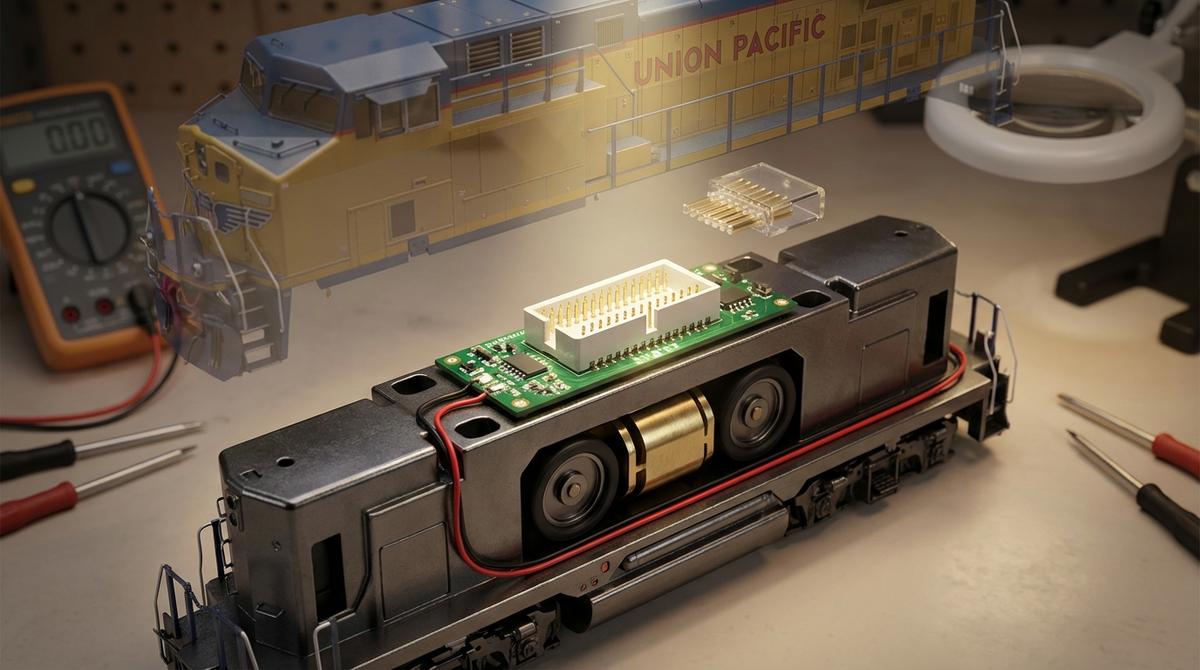
After forty years of building houses, I thought I understood construction. Then I bought my first HO locomotive with a 21-pin socket and realized the model railroad industry has its own building code. The good news? Once you crack the code, HO scale DCC ready locomotives offer the best path to digital control without blowing your budget or your patience.
I've converted dozens of locomotives since retiring to my workshop in Hudson, Wisconsin, and I've made every mistake in the book. So let me save you some frustration and some money.
Here's where the marketing department earns its paycheck. DCC Ready means the locomotive has two things going for it: an isolated motor and a socket waiting for a decoder. That's it. The motor isn't directly connected to the track pickups, so when you plug in a decoder, the decoder can control everything.
Most modern HO scale DCC ready locomotives come with a dummy plug installed. This little circuit board routes track power straight to the motor and lights, letting you run on DC while you save up for a decoder. Pop out the dummy, plug in your decoder, and you're running digital. Takes about ten minutes if you don't drop any screws into the mechanism.
But here's what the box won't tell you: DCC Equipped means a decoder is already installed. DCC Sound Equipped means you're getting the full package with sound and speaker. The price jump between ready and equipped can run anywhere from $40 to $150, which is why knowing your options matters.
This is where things get interesting. Just like electrical outlets in different countries, model railroad manufacturers settled on several different socket standards. Get the wrong decoder for your socket, and you're either doing surgery or sending it back.
The 8-pin NEM 652 connector is the granddaddy of the bunch. It's simple, nearly foolproof to install, and still shows up on plenty of locomotives. You get four basic functions: headlight, taillight, and two aux outputs. Limited, sure, but reliable.
The 21-pin MTC connector has become the go-to standard for most major brands. Athearn Genesis 2.0, ScaleTrains, and Walthers all use it. The extra pins give you more function outputs for things like ditch lights, cab lights, and number boards.
But there's a trap waiting. Some manufacturers wire their AUX3 and AUX4 outputs as logic-level only. That means they send a signal but don't provide enough juice to actually light an LED. Install certain decoders expecting powered outputs, and your ditch lights stay dark. ESU decoders typically handle this, but drop in a SoundTraxx or TCS decoder and you might be scratching your head wondering why nothing works.
On smaller locomotives, you'll find the compact 6-pin NEM 651. It's common in N scale and small HO models like European switchers. The catch? It lacks the blue common positive wire, which means lighting has to be wired differently than on larger decoders.
European manufacturers like Roco and PIKO favor the PluX22 standard (NEM 658). Meanwhile, Next18 is gaining ground in tight spaces. The Next18 has a symmetrical design that prevents damage if you accidentally insert it backwards. Some modelers are already standardizing on Next18 for their smaller power.
Picking a DCC-ready locomotive in 2025 isn't just about paint schemes. The brand you choose determines the mechanism quality, the decoder compatibility, and how much support you'll get when something goes wrong.
If I could only recommend one brand to a newcomer, it would be ScaleTrains. Their Operator line runs about $125 for a DCC-ready diesel, and here's the thing that blew my mind: the Operator uses the exact same drivetrain as their premium Rivet Counter series. Same 5-pole skew-wound motor. Same helical gears. Same heavy die-cast frame. You're just getting simplified paint and molded-on grab irons instead of separate applied parts.
Their two-year warranty is the best in the business. When you're talking about electronics that can fail, that matters.
Walthers Mainline locomotives share the same proven drive as their Proto line. The SD70ACe review showed what these mechanisms can do. Heavy die-cast chassis, helical-cut gears, quiet running. Their Mainline models come sound-ready with speakers pre-installed, which saves you the hassle of finding one that fits.
Atlas has been doing this longer than most of us have been in the hobby. Their Master Silver line delivers consistent quality with either 21-pin or 8-pin sockets depending on the model. Forum discussions consistently place Atlas among the most reliable brands, right up there with Kato.
The Athearn Genesis line represents the upper tier of mass-produced HO locomotives. The detail work is exceptional, and the mechanisms have improved over the years. Early Athearn RTR models had a reputation as coffee grinders, but the modern Genesis 2.0 diesels run smooth and quiet.
Kato locomotives are almost legendary for their mechanism quality. Ask ten experienced modelers which brand runs smoothest, and Kato will be on most lists. Their dual brass flywheels and precision gearing produce running characteristics that other manufacturers aim for but rarely match.
BLI makes locomotives that pull. Their heavy die-cast chassis gives excellent tractive effort. The company brought back their Stealth Series in 2023, offering DCC-ready versions of their premium models at about $100 less than the sound-equipped Paragon4 versions. That's a big deal for modelers who want to choose their own sound decoder.
The caveat: some forum discussions mention past reliability issues with BLI electronics. The mechanical side seems solid, but do your research on specific models before buying.
Rapido locomotives feature prototype-specific detail that makes rivet counters weep with joy. Their sound-ready versions come with speakers installed. The downside? Some Rapido motherboards only work properly with ESU decoders. Install a SoundTraxx decoder and features like class lights may not function. That's a frustrating discovery after spending $100 on a decoder.
Let's do some math, because this is where DCC-ready locomotives really shine.
Start with a ScaleTrains Operator diesel at $125. Add an ESU LokPilot non-sound decoder at around $35. Your total: about $160 for a locomotive that runs as well as anything twice the price.
Here's where it gets interesting. A factory sound-equipped locomotive typically costs $80-$100 more than the DCC-ready version. But an ESU LokSound 5 decoder runs about $95. You're paying roughly the same, but you get to choose your decoder brand and load whatever sound file you want.
Some modelers question the price jump for sound, and I get it. If you're running a club layout with fifteen locomotives, those costs add up fast. But sound on your lead unit while everything else runs silent? That's a reasonable compromise.
Budget another $25-40 for a keep-alive capacitor. TCS Keep Alive units and ESU PowerPack Mini capacitors provide several seconds of backup power. On dirty track or when crossing unpowered frogs, that backup keeps your locomotive moving and your sound playing. I consider them mandatory equipment now.
I've installed enough decoders to have a system. Here's the condensed version of what works.
Run the locomotive on DC first. Listen to it. Feel how it accelerates and stops. If something's wrong mechanically, you want to know now, not after you've installed a $100 decoder.
Measure the stall current with an ammeter while gently holding the wheels. Your decoder's continuous amperage rating must exceed this number. Most HO decoders handle 1-2 amps, and most HO motors stall under 0.5 amps, but check anyway.
The most critical test is motor isolation. Use a multimeter set to continuity and check between the motor terminals and the frame. You should get no beep, no connection. Any electrical path between motor and frame will destroy your decoder the instant you power it up.
For locomotives with standard sockets, the process is genuinely plug-and-play. Remove shell, pull dummy plug, insert decoder, replace shell. I've done it in under five minutes.
On 21-pin sockets, pay attention to orientation. Look for the marker indicating pin 1 and align your decoder accordingly. Unlike the Next18, a backwards 21-pin decoder can be damaged.
If you're adding sound to a DCC-ready locomotive, check whether a speaker is pre-installed. Models from BLI's Stealth Series usually include one, though some Stealth SD40 variants may not.
The SoundTraxx installation guide covers the fundamentals. Speakers need sealed enclosures or baffles to produce decent sound. The little "sugar cube" speakers work well in tight spaces if you give them a proper chamber. I've mounted them in fuel tanks, under cab roofs, and in custom enclosures built from sheet styrene.
Place the locomotive on a programming track and read CV8 to confirm the installation worked. If your system can read the manufacturer ID, you're connected. Reset to factory defaults by writing a value of 8 to CV8, then program your address and basic CV settings.
For ESU decoders, the Auto Tune feature automatically adjusts motor control parameters. It's not perfect, but it gets you 90% of the way to smooth slow-speed operation.
After building four layouts and watching dozens of locomotives run, I've developed a sense for what separates good mechanisms from mediocre ones.
Top-tier locomotives can maintain a steady crawl at 1 scale mile per hour or less at DCC speed step 1. That's walking pace for a six-foot-tall person. At that speed, the model should move smoothly without jerking or stalling. Prototypical switching operations depend on this kind of control.
You can measure locomotive speed with a scale speedometer, but honestly, your eyes will tell you what you need to know. Does it creep convincingly? Or does it lurch from stop to 20 scale mph with nothing in between?
Drawbar pull should be about 25% of the locomotive's weight. A heavy die-cast frame helps, and most modern mechanisms from ScaleTrains, Walthers, Atlas, and Athearn deliver solid pulling performance. MTH locomotives with Proto-Sound 3.0 have a particularly strong reputation for tractive effort.
For DCC layouts, the RRampMeter gives you accurate current readings on the square-wave DCC signal that confuses standard multimeters. A healthy HO locomotive should draw less than 0.5 amps at stall. If you're seeing higher numbers, something's binding in the drivetrain.
Factors like 5-pole skew-wound motors, dual flywheels, and helical-cut gears consistently appear in well-performing locomotives. Atlas Master Gold models hit these marks, as do Athearn Genesis diesels.
I spend more time on model railroad forums than my wife thinks is healthy. But that's where you learn which brands deliver and which ones disappoint.
When newcomers ask for locomotive recommendations, certain names appear repeatedly. Kato for mechanism quality. Atlas for reliability. ScaleTrains for value. Experienced modelers rank these brands based on years of personal experience, and the consistency of those rankings tells you something.
Walthers Mainline frequently gets recommended as a best-value option because you're getting the same drive mechanism as the premium Proto line at a lower price point.
Decoder lock-in frustrates modelers who want to choose their own equipment. Rapido's ESU-centric design is a common complaint. So are proprietary light boards that limit your decoder options.
Poor customer support ends brand loyalty faster than anything else. Many advanced modelers prefer DCC-ready locomotives specifically because they can install their preferred decoder brand and avoid factory electronics they don't trust.
For modelers running HO scale with its 1:87 ratio and 16.5mm gauge, compatibility between brands is generally good. Both NMRA and NEM/MOROP standards govern the specifications, and most North American manufacturers follow NMRA guidelines.
Where you'll run into trouble is with European imports running on North American track. NEM wheel flanges can hit spike heads on Code 83 rail, and frog flangeway dimensions differ enough to cause derailments. If you're mixing equipment, test everything before blaming the decoder.
For narrow gauge HO models like HOn3 or HOn30, space constraints make decoder installation more challenging. Sound in geared steam locomotives often requires micro decoders and creative speaker placement. Keep-alive capacitors become almost mandatory on these short-wheelbase locomotives to maintain power through turnouts.
The DCC-ready market keeps evolving. ESU's LokSound 5 Nano decoder measures just 19.6mm x 8.5mm, small enough to fit in locomotives that previously couldn't accept sound. That opens possibilities for small steam and switchers that were impossible to convert five years ago.
Wireless control is gaining momentum. Digitrax's LNWI, MRC's WiFi module, and open-source systems like DCC-EX let you run your layout from a smartphone. Hornby's HM7000 system even puts Bluetooth directly in the decoder.
ScaleTrains acquired MTH's HO and S scale tooling in 2021. MTH is out of the new locomotive business, but their existing Proto-Sound 3.0 models will be supported by an independent service entity. The tooling will likely reappear as ScaleTrains models with ESU electronics.
After four layouts and more decoder installations than I can count, here's my approach to building a locomotive roster:
Buy DCC-ready for your workhorses. A ScaleTrains Operator ES44 at $129 gives you a top-tier mechanism ready for whatever decoder you choose. Athearn RTR locomotives and Walthers Mainline models offer similar value.
Standardize on one decoder ecosystem. Whether you pick ESU, SoundTraxx, or TCS, staying with one brand means you learn the CVs, the programming software, and the quirks. My fleet runs ESU because I invested in the LokProgrammer, and now every locomotive programs the same way.
Sound on lead units, silence on the rest. You only hear what's up front anyway. Save the money on your trailing units and helper locomotives.
Install keep-alives everywhere. The difference in operation over turnouts is dramatic. No stalls, no sound dropouts, no hesitation. It's one of the best upgrades you can make.
Check before you buy. For 21-pin locomotives, read the manual or search the forums to verify whether the aux outputs are powered or logic-level. Five minutes of research saves hours of frustration.
HO scale DCC ready locomotives give you control over your fleet that wasn't possible a decade ago. The industry has standardized enough that swapping decoders is straightforward, and the quality of mechanisms at every price point has improved. Whether you're running Soo Line power like me or modeling some other prototype, the path to digital control has never been more accessible. You just have to know where the trap doors are, and now you do.
By Harold LindgrenBuild Your Dream Railroad with Innovative Hobby Supply!
?️ Complete Your Layout: Explore our wide selection of Photo Real buildings, diorama backdrops, detail parts, and accessories in every popular scale.
✨ Unmatched Realism: From chrome detailing products to neon lighting kits – every piece is designed to make your miniature world come alive.