
HO Scale Building Kits for Beginners: Your First Structure Without the Frustration
Posted by Tony Marchetti on 30th Dec 2025
Order by phone: 763-231-7847
Free Shipping On Orders Over $100!
If you are already registered, please log in.
Create your account and enjoy a new shopping experience.
Create A New AccountPosted by Tony Marchetti on 30th Dec 2025
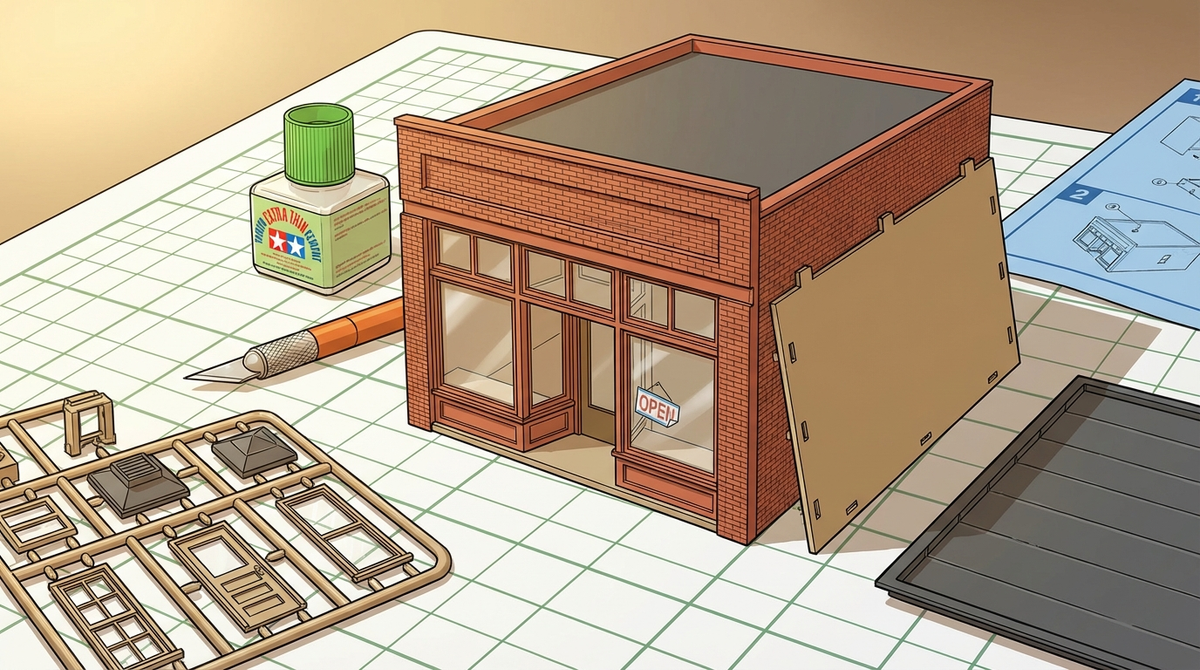
Look, I spent 28 years fixing things at the CTA's Skokie Shops. I know what it's like to stare at a pile of parts and wonder where to even start. Building your first HO scale structure kit can feel the same way, except nobody's going to fire you if you glue something backwards.
Here's what I wish someone had told me when I started: the hobby isn't as complicated as the internet makes it seem. You don't need a basement full of tools or an art degree. You need the right kit, a few basic supplies, and about three hours on a Saturday afternoon.
I'm going to walk you through everything, from picking your first kit to fixing the mistakes you're definitely going to make. Because trust me, you will make them. We all do. The trick is knowing how to recover.
There's a reason HO scale dominates the hobby. At 1:87.1, it hits that sweet spot where models are big enough to show off real detail but small enough that you can build a decent layout on a 4x8 sheet of plywood. You don't need to dedicate your entire basement to it.
The other advantage? Selection. When 60-70% of all North American model railroad products are made in HO, you've got options. Lots of them. At competitive prices. That's simple economics at work.
The widespread availability means you'll find tutorials everywhere. YouTube channels, forum threads, manufacturer instructions. When you get stuck, someone has already posted the answer. That kind of community support cuts your learning curve in half.
I run O gauge myself because that's what my old man had around the Christmas tree in Cicero. But I'll tell you straight: if I were starting fresh today with limited space and budget, I'd go HO. The math just works out better.
Walk into any hobby shop and you'll see structure kits ranging from ten bucks to over a hundred. The price differences aren't random. They reflect different materials, skill requirements, and time investments.
If you've never built anything before, start here. Bachmann Plasticville kits snap together without glue, and the parts come molded in realistic colors so painting is optional. You can knock one out in under an hour.
Are they as detailed as fancier kits? No. But you know what? A simple snap-together building on your layout beats an expensive kit sitting unbuilt in a box. Get something finished. Feel that satisfaction. Then move on to harder stuff.
This is the meat of the market. Walthers Cornerstone dominates this space, offering everything from small storefronts to massive industrial complexes. DPM (Design Preservation Models) kits are another solid choice, especially if you want to modify things later.
The big advantage of modern plastic kits? Many now come molded in multiple colors. A brick building has red brick walls, gray foundation, and separate colored trim pieces. That cuts your painting time dramatically. For a beginner, that's huge.
Expect to spend 2-5 hours on a typical Cornerstone kit. You'll learn gluing, squaring walls, applying decals, and basic weathering. These are the skills that transfer to every future project.
The phrase "craftsman kit" used to mean "experts only." Not anymore. Companies like American Model Builders now offer LASERkit Xpress lines designed specifically for first-timers. Their One-Car Garage kit runs about fifteen bucks and takes under two hours.
Bar Mills' Over-Nighter series takes it even further. These kits feature pre-printed, weathered walls. You're basically getting wood that already looks old and worn. No painting, no staining required. Just glue it together and you've got something that looks like it's been trackside for decades.
Wood kits teach you different skills than plastic: managing moisture to prevent warping, layering parts for depth, and working with PVA glue. Consider one for your second or third project once you've got a plastic build under your belt.
Woodland Scenics Built-&-Ready buildings arrive fully assembled, painted, and often pre-lit. You open the box, set it on your layout, and you're done. Menards offers similar options at competitive prices, sometimes with animated signs.
I'm not going to pretend these are for everyone. They cost more and you don't learn anything building them. But if you're the type who wants to focus on operations rather than construction? Or you're filling out a layout fast? They have their place. No judgment from me.
Here's where most guides mislead you. They quote the kit price and call it a day. That's like telling someone a car costs $25,000 but forgetting to mention insurance, gas, and maintenance.
Your real first-project cost includes tools and supplies you'll reuse for years. Let me break it down honestly.
Snap-fit plastic kits: $12-36. Bachmann's gas station is a classic starter.
Glue-together plastic: $20-65. A Walthers storefront typically runs $25-45.
Beginner laser-cut wood: $15-50. American Model Builders' Company House hits around $15.
Good news: the tool investment is lower than you'd think. About $40-60 sets you up for years.
Sprue cutters for removing plastic parts cleanly: $15-25. Tamiya's Sharp Pointed Side Cutter is the gold standard, but budget options work fine for starting out.
Hobby knife with #11 blades: around $15. Basic kits with blades give you everything you need.
Needle files and sanding sticks: $9-15 combined. You'll use these more than you expect for cleaning up parts.
Tamiya Extra Thin Cement: about $9. This is the good stuff for plastic. It works by capillary action, wicking into joints for clean welds.
PVA glue (Elmer's or Aileen's Tacky): $5 or less. Essential for clear parts and wood.
CA glue (super glue): around $8. Keep medium-viscosity on hand for metal and mixed-material joins.
This is where beginners get blindsided. A basic acrylic paint set runs $30-45. Add primer ($8-15) and matte varnish ($8) for sealing. Brushes add another $14-18.
Total paint budget: $40-70.
Here's my advice: for your first kit, choose one that's molded in color. Defer the paint expense. Focus on learning assembly. Buy paints later when you're ready to tackle finishing.
I'm going to walk you through this like I was standing next to you at the bench. We'll use a typical Walthers Cornerstone kit as the example, but these steps apply to any plastic structure.
Set up your workspace first. Good lighting, a cutting mat to protect your table, and enough room to spread out. Don't work hunched over your kitchen table in bad light. Your back and your results will both suffer.
Open the box, find the instruction sheet, and actually read it. I know, I know. But the five minutes you spend understanding the assembly sequence saves thirty minutes of frustration later.
Now wash all the plastic parts in warm soapy water. Yeah, seriously. The mold release agents left from manufacturing will mess with paint and glue adhesion. Let everything air dry completely.
Use your sprue cutters to clip parts off the plastic frame. Cut a few millimeters away from the actual part, then make a second closer cut. Never twist parts off. You'll stress the plastic and possibly crack something.
Clean up the remaining nub with a hobby knife or sanding stick. Run your finger over it. If you can feel a bump, keep working. Those little imperfections show through paint and ruin the illusion.
Here's where impatient builders go wrong. Before any glue touches anything, dry fit all the main parts together. Hold the walls up, see how they meet. Are the corners clean? Do any edges need sanding for a better fit?
Fix problems now when they're easy to address. Once glue sets, your options get limited fast.
Build in sub-assemblies rather than trying to glue everything at once. Put the windows and doors into their wall sections first. Let those cure. Then join walls together.
When you do glue walls, use your hobby square to ensure 90-degree corners. Apply liquid cement sparingly to the inside joint and let capillary action do the work. Less is more here. Glue running down your walls looks terrible.
Use clamps or rubber bands to hold things square while cement cures. Don't trust your hands to stay steady for ten minutes.
Attach window glazing to the inside of window frames using PVA glue or clear parts cement. Never use regular plastic cement or CA glue on clear parts. The fumes will fog the plastic permanently. I'll talk more about that in the mistakes section because everyone makes this error at least once.
If your kit includes decals for signs, apply a gloss coat to the surface first. Use Micro Set and Micro Sol to help decals conform to surface textures like brick mortar lines. Without setting solution, you'll get silvering where air gets trapped under the decal film.
Once everything's assembled and decaled, a coat of matte varnish kills the plastic shine and protects your work. Testors Dullcote is the standard.
After a plastic kit or two, you're ready for wood. The laser-cut precision of modern kits makes assembly straightforward, but wood behaves differently than plastic. Respect those differences and you'll avoid headaches.
Wood warps when moisture hits one side but not the other. Paint a wall's front without sealing the back and it'll curl like a potato chip.
Before you remove any parts from the laser-cut sheet, spray both sides with primer. This seals the wood evenly and prevents warping. I don't care if you're planning to stain instead of paint. Seal both sides with something before proceeding.
American Model Builders specifically recommends this approach, and they'd know. They designed the kits.
With wood kits, you paint the parts while they're still in the sheet. Much easier than trying to brush tiny trim pieces after they're glued in place. Blair Line's assembly guide walks through this technique in detail.
Use a sharp hobby knife to cut parts from the frets after painting. Wood's more delicate than plastic, so take your time.
Standard PVA wood glue is your primary adhesive. It grabs quickly and dries clear. For attaching metal castings or plastic detail parts, switch to CA glue.
Many Bar Mills kits include peel-and-stick roofing. Paint it while still on the backing sheet, then apply directly to the roof substrate. Burnish with your finger for good adhesion.
Even after assembly, hit the finished model with clear matte sealer. This further protects against humidity changes and locks in your weathering. Wood structures need this step more than plastic ones.
An illuminated building at night transforms a layout from "collection of models" to "believable miniature world." The good news: you've got two paths to get there, and neither requires being an electrician.
If the thought of wiring makes you nervous, Woodland Scenics' Just Plug system is your friend. It's modular, expandable, and genuinely idiot-proof.
A Power Supply (about $23) connects to a Light Hub (around $15-18) which accepts four lights with individual dimmer controls. Need more? Add an Expansion Hub and chain additional Light Hubs. One power supply handles up to 50 lights total.
Their pre-wired LEDs just plug into the hub. No soldering, no calculations, no fuss. The downside? Cost adds up. Expect to spend $55-65 to light your first four buildings.
Willing to learn some basic skills? DIY lighting costs pennies per building.
Pre-wired LEDs with resistors run about $8 for a 20-pack. Add a 12V DC power supply ($10-15) and you're in business. Total per-building cost? Under a buck.
The critical rule: always use a current-limiting resistor with LEDs. Connecting an LED directly to 12V without a resistor will instantly fry it. The resistor value depends on your LED's specifications. For typical white LEDs on 12V, a 680 ohm resistor works.
Yes, you'll need to learn to solder. It takes maybe an hour of practice to get competent. YouTube has dozens of tutorials. The payoff in flexibility and cost savings is worth it.
I've watched beginners screw up the same ways for decades. These errors are predictable, preventable, and mostly fixable. Consider this your cheat sheet.
This one hurts because it's so avoidable. Standard CA glue releases fumes as it cures. Those fumes fog clear plastic. Use it near windows and you'll get a hazy, frosted mess.
Prevention: Use PVA-based glue or specialty canopy glue on all clear parts. Pacer Formula 560, Microscale Micro Kristal Klear, or plain old white glue all work without fogging.
If you must use CA nearby, pick an odorless foam-safe variety and ensure good ventilation.
Rescue: Light fogging can sometimes be polished out with Novus Plastic Polish. Worse cases might respond to a dip in Pledge Floor Gloss. Really bad damage means cutting new window glazing from clear styrene sheet.
You glued the walls together and now the building sits crooked. Gaps at corners. Roof doesn't fit right.
Prevention: Always use a square when joining walls. Magnetic gluing jigs exist specifically for this. Don't trust your eyeball.
Rescue: If walls are slightly out of square but already glued, add internal styrene bracing strips. Cut Evergreen square stock to fit inside the corners and glue it to force the walls into alignment. Fill visible gaps with modeling putty, sand smooth, repaint.
Your laser-cut walls came out bowed. Assembly's now impossible.
Prevention: Always seal both sides of wood parts before removing from the fret. Paint or primer, doesn't matter. Just equalize moisture exposure.
Rescue: For warped plastic parts (yes, this technique works there too), immerse in hot water until pliable, then weight flat on glass until cool. A heat gun also works with care. After straightening, brace the back side to prevent recurrence.
Your paint's coming off in sheets, or the surface looks like citrus fruit.
Prevention: Always wash parts before priming. Always prime before painting. Apply thin coats. Multiple light passes beat one heavy coat every time.
Rescue: Let everything cure completely, then carefully sand smooth with fine-grit paper. For runs, slice off the drip with a sharp blade first. Clean, reprime, repaint with thinner coats.
The clear carrier film around your decal shows as a silver sheen against the paint.
Prevention: Apply decals only to glossy surfaces. Spray a gloss clear coat over matte paint before decaling. Use Micro Set and Micro Sol to help decals conform to surface detail.
Rescue: Sometimes additional Micro Sol applications work. Often, the only fix is removing the decal and starting over on a properly prepared surface.
You don't need expensive aftermarket parts to make a kit stand out. These cheap tricks punch way above their weight.
A generic building becomes a specific business with the right sign. Design them in Word or Canva, print on matte photo paper, cut out, glue in place. For that painted-on-brick look, print on regular paper and apply with matte Mod Podge. Lightly sand edges and add a dirty wash to blend the sign into the weathered walls.
Backlit empty buildings look like toys. Print images of store shelves, office furniture, or restaurant seating from Google Images. Scale them to fit your windows, glue to cardstock set back from the glass. The Gateway NMRA offers free downloadable interior photos specifically for modelers.
Ready-made alternative: City Classics Picture Window Photos run about $6 and include shadowbox frames.
Vary your windows instead of leaving them all blank. Cut paper rectangles in cream or dark green, glue to window backs as shades. Roll the bottom around a toothpick for a realistic roller shade profile. Tissue paper makes passable curtains. Black paper angled behind upper windows blocks sightlines without looking like voids.
Real roofs get patched. Replicate that with black construction paper or painted medical tape. Cut irregular rectangles, glue randomly across the roof surface. Let some corners lift slightly. Dust edges with gray weathering powder to simulate dried tar. Instant age.
The fastest way to kill plastic shine and add believability. Buy a cheap set of artist's pastel chalks in earth tones: black, gray, browns, rust colors. Scrape powder with a knife, brush onto the model. Focus on bases of walls, corners, horizontal surfaces where dirt accumulates. Seal with matte spray to lock it in.
Total investment: under $10 for chalks that'll last years.
I'm going to be blunt here because this matters. The solvents in plastic cement and paint can hurt you if you're careless. Tamiya Extra Thin's safety data sheet specifically warns about flammability and vapor hazards.
Work in a well-ventilated area. Period. For spray painting or heavy cement use, a spray booth that ducts fumes outside is ideal. A DIY version using a cardboard box and exhaust fan works, but keep the fan motor outside the airflow path since you're dealing with flammable vapors. Aim for 300-400 CFM extraction capacity.
For airbrushing lacquers or enamels, wear a respirator with organic vapor cartridges. A NIOSH-approved N95 works for water-based acrylics if you're only brush painting. Don't cheap out on lung protection.
Wear ANSI Z87.1-rated safety glasses. Plastic bits can fly when you're cutting, and solvent splashes happen. Eyes don't grow back.
Always cut away from your body. Keep your non-cutting hand out of the blade path. Use sharp blades because dull ones require more pressure and slip more easily. Cap your knife when not in use.
Super glue bonds skin instantly. Keep it away from your eyes. If you glue your fingers together, use BSI Un-Cure debonder or soak in warm soapy water and gently roll the skin apart. Never pull. And never, ever wear cotton gloves when using CA. The exothermic reaction between CA and cotton can cause serious burns.
Hunching over poor lighting for hours wrecks your neck and back. Set your bench at proper height, use an adjustable chair, and take breaks. Good task lighting at 5000K-6500K lets you see true colors and fine detail. Your older self will thank you.
You've got more choices than ever for sourcing kits. Each option trades off differently between price, selection, and service.
Walthers is the 800-pound gorilla. As North America's largest distributor, they stock their own Cornerstone line plus 175+ other brands. They run monthly sale flyers and have a loyalty program. Shipping's pricey though: $14.95 economy with a $299 free shipping threshold.
Model Train Stuff offers competitive pricing and something useful: 10% down on preorders. Good for securing hot new releases without full payment upfront.
TrainWorld has huge inventory and email coupon deals, but watch their return policy: up to 15% restocking fee. Shipping runs around $10 minimum.
Midwest Model Railroad ships fast, often same or next business day. Their laser-cut kit selection with clear stock levels makes ordering painless.
Woodland Scenics sells their full DPM and Just Plug lines direct. Bar Mills guarantees replacement parts for direct purchases but not secondary market buys. Atlas maintains an online store for their structure kits.
Otter Valley Railroad stocks a solid HO structure selection with prices in CAD. Credit Valley Railway ships across Canada but has a tight 5-day return window. Note that HobbyTech Canada no longer ships to the US due to customs complexity.
Nothing beats hands-on browsing at a local hobby shop. Use the Walthers dealer locator to find shops near you. For discontinued kits, train shows and eBay are your best bets. On eBay, stick to high-feedback sellers and transactions covered by the Money Back Guarantee.
Building skills takes time. Don't try to jump from zero to craftsman overnight. Here's a realistic 18-month progression that builds capability systematically.
Start with a Bachmann Plasticville snap-fit kit. No glue, minimal tools. Focus on reading instructions and understanding how parts go together. One or two hours, you're done. Put it on your layout. Feel good about finishing something.
Graduate to a Walthers Cornerstone kit that requires glue. Learn proper cement application, squaring corners, decal setting techniques. Try basic weathering. These are the fundamentals you'll use forever.
Try a beginner laser-cut wood kit or a Bar Mills Over-Nighter. Learn to handle wood's unique properties: sealing against warp, staining, working with PVA adhesive. You're expanding your material vocabulary.
Combine two kits into something unique. Cut and fit styrene to modify footprints. Add interior lighting. Learn light-blocking techniques. You're no longer just following instructions. You're designing.
Take on a multi-media craftsman kit with wood, resin, and metal parts. Master different adhesives for different materials. Complex instructions. Advanced weathering. By the end, you have the skills to scratchbuild from raw materials if you want.
Enough reading. Time to build.
Pick up a Plasticville kit or a molded-in-color Walthers Cornerstone. Grab basic tools: cutters, knife, Tamiya cement, a hobby square. Set up somewhere with good light and ventilation.
Saturday: wash parts, remove from sprues, dry fit, glue main walls. Let cure overnight.
Sunday: attach details, install windows and glazing, apply decals if included. Place finished model on your layout.
That's it. You've built your first structure. The second one goes faster. The tenth one will surprise you with how good it looks. But it all starts with getting off the internet and opening that first box.
Go build something.
? Complete Your Layout: Explore our wide selection of Photo Real buildings, diorama backdrops, detail parts, and accessories in every popular scale.
✨ Unmatched Realism: From chrome detailing products to neon lighting kits – every piece is designed to make your miniature world come alive.