
Best N Scale Manufacturers Ranking: Who Actually Delivers in 2025
Posted by Harold Lindgren on 31st Dec 2025
Order by phone: 763-231-7847
Free Shipping On Orders Over $100!
If you are already registered, please log in.
Create your account and enjoy a new shopping experience.
Create A New AccountPosted by Harold Lindgren on 31st Dec 2025
After spending 40 years building houses, I've developed a pretty simple philosophy: buy quality tools from companies that stand behind their work, or you'll waste more time fixing problems than actually getting things done. That same logic applies to N scale model railroading.
I've been running trains on my Soo Line layout for seven years now, and I've learned the hard way which manufacturers deliver and which ones leave you chasing gremlins at 11 PM on a Tuesday. The N scale market has changed dramatically since I started, and the landscape today looks nothing like it did even three years ago. New players have arrived, old standards have been acquired, and the technology has leapfrogged in ways that would have seemed impossible a decade ago.
What follows is my honest assessment of where things stand. I've talked to club members, dug through the locomotive encyclopedia at Spookshow, read countless forum threads, and most importantly, run these products on actual track. Your mileage may vary, but if you're trying to figure out where to spend your hard-earned cash, this should give you a solid starting point.
Not all N scale brands are created equal. Some have earned their reputation through decades of consistent performance. Others have disrupted the market with fresh approaches. Here's who sits at the top of the heap and why.
If you ask ten experienced N scalers which brand runs best out of the box, eight or nine will say Kato without hesitation. That's not brand loyalty talking. It's simple observation.
I've got Kato locomotives that have been running since 2018 without a single hiccup. Their five-pole motors with dual brass flywheels deliver the kind of smooth, silent operation that makes other manufacturers jealous. Slow-speed performance is exceptional. You can creep along at a scale 2 mph without any stuttering or jerking.
The Unitrack system deserves its own mention. Yes, some modelers dismiss sectional track as too toylike, but Kato's snap-together system is the most robust option available for N scale. Those UniJoiners make solid electrical connections every time. I've helped friends build T-TRAK modular layouts where Unitrack performed flawlessly through hundreds of hours of club operations.
The variety of track configurations available lets you build anything from a simple oval to complex multi-level designs. The 2024 catalog shows just how expansive their selection has become.
Where does Kato fall short? Their 60-day warranty is the shortest in the industry. And while their detail has improved over the years, they don't match the bleeding-edge precision of some newer competitors. But when I'm buying a locomotive that needs to pull a 30-car freight through three hours of operations without drama, Kato is still my first call.
Their repair service operates with a 6-8 week turnaround, and they maintain an online parts store for common replacement items. Just know that they won't service aftermarket DCC installations if something goes wrong.
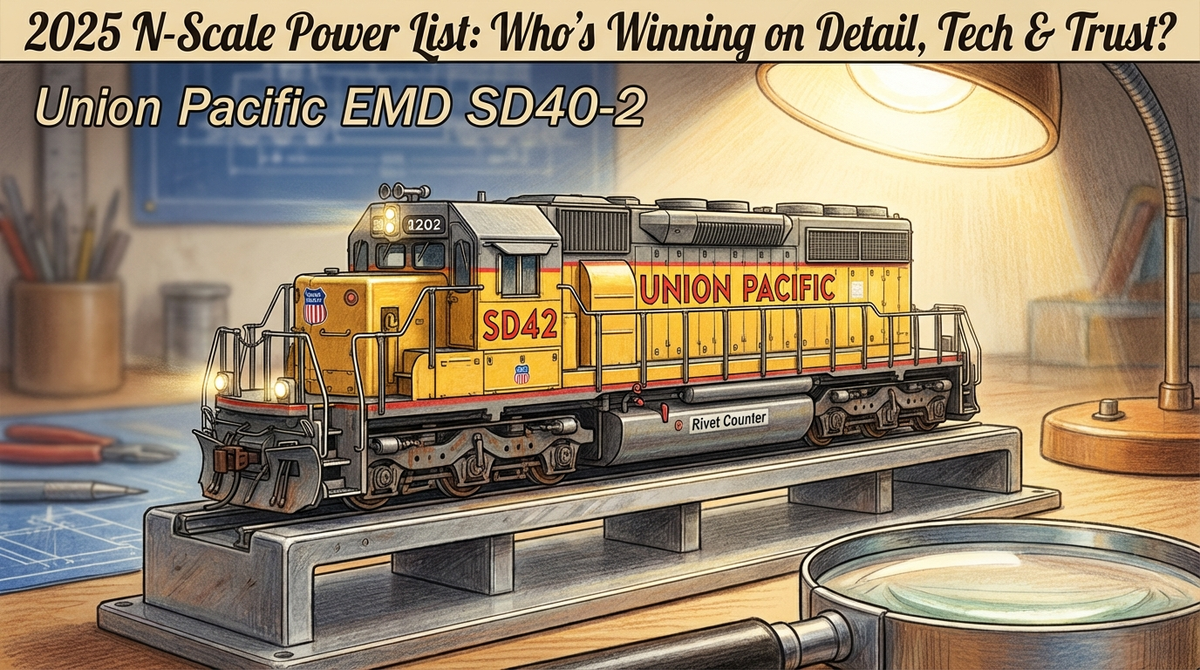
When ScaleTrains launched their Rivet Counter line, they essentially told the rest of the industry that mass-produced plastic models could achieve near-brass levels of accuracy. And then they proved it.
Take their SD40-2. We're talking factory-applied wire grab irons, see-through etched metal grilles, and road-number-specific tooling that captures the character of individual prototypes. The F59PH announcement showed extensive separately applied parts that rival what you'd expect from high-end HO models.
I've handled their DM&E SD40-2 and the Missouri Pacific version. The underframe detail alone would have required hours of kitbashing to achieve a decade ago. Now it comes straight from the factory.
ScaleTrains has been aggressive about adopting new DCC technology, including the ESU E24 socket. Their factory sound models ship with ESU LokSound V5 decoders, and the AC4400CW manual shows just how sophisticated their electronics package has become.
The catch? These aren't cheap. DCC and sound-equipped locomotives often run north of $300. And their limited-run model means popular road names sell out fast. If you see something you want on pre-order, don't wait.
Their two-year warranty for direct purchases provides peace of mind, and community feedback suggests their running quality matches Kato. The acquisition of ExactRail and Fox Valley Models expanded their freight car offerings considerably.
Atlas has been a reliable presence in N scale for decades, and their breadth of offerings makes them a one-stop shop for many modelers. Their catalog spans locomotives, rolling stock, and track across multiple price points.
The Master line represents their premium offerings, while Classic and Trainman serve mid-range and entry-level markets. Their GP38-2 Phase 1 has earned praise for both performance and accuracy.
What sets Atlas apart is their Code 55 track. If you want the most prototypical-looking rails in N scale, this is it. Fine brown ties, small rail profile, gorgeous appearance. The track catalog shows an extensive selection of turnouts and flex track.
There's a tradeoff, though. Atlas Code 55 demands NMRA-compliant low-profile wheels. Run older rolling stock with deep flanges, and you'll get derailments from flanges bumping on spike heads. This isn't a flaw in the track. It's a conscious design choice for maximum realism that requires commitment.
The November 2025 acquisition of Micro-Trains represents the biggest shakeup in N scale in years. Atlas now controls the benchmark brand for N scale rolling stock and couplers. The "Micro-Trains by Atlas" products should start appearing in 2026.
Newer Atlas locomotives feature Next18 and ESU E24 interfaces, making DCC installation plug-and-play. Gold Series models come with factory ESU LokSound. Their production schedule operates on a pre-order system, so planning ahead is required.
The one-year warranty beats Kato's 60 days, and their support network should only improve with the Micro-Trains integration.
For decades, Micro-Trains Line has defined quality in N scale rolling stock. Their freight cars set the bar that others chase.
But the real reason Micro-Trains matters? Their Magne-Matic knuckle couplers. If you've ever tried to back a 40-car train through an S-curve without derailments, you understand why coupler quality matters. MTL couplers are the operational standard for club layouts and serious operations precisely because they work reliably every single time.
The case for body-mounted couplers becomes obvious when you're switching in tight quarters. Truck-mounted couplers let the trucks skew, which causes problems when backing. Micro-Trains figured this out years ago.
Their monthly releases keep collectors engaged, with new road names and special editions appearing regularly. The June 2025 releases show their continued commitment to variety.
With the Atlas acquisition, production transitions to Atlas networks in 2026. What this means for pricing and availability remains to be seen. Smart modelers might consider stocking up on essential trucks and couplers during the transition.
N scale isn't just a North American hobby. Japanese, British, and European prototypes have their own dedicated manufacturers, each with distinct strengths.
Here's something that trips up newcomers: Japanese N scale runs at 1:150 ratio, not the 1:160 used for North American prototypes. Both use 9mm gauge track, so the trains will physically run on the same rails, but proportions differ slightly.
Tomix dominates the Japanese domestic market with an enormous catalog of EMUs and Shinkansen. Their FineTrack system offers more prototypical appearance than Kato Unitrack, with wider variety of turnouts and curves.
The Unitrack vs FineTrack debate comes down to priorities. Unitrack wins on ease and reliability. FineTrack wins on realism and flexibility. Tomix's High Grade products now match Kato quality, though distribution outside Japan requires importing.
Tomix TN couplers provide realistic tight coupling between cars. If you're modeling Japanese prototypes, running both brands makes sense.
British N gauge uses 1:148 scale, another subtle but real difference from the North American standard.
Graham Farish, owned by Bachmann, has improved dramatically in recent years. Their locomotives now ship with Next18 DCC sockets and factory-installed Zimo sound decoders as options.
Dapol pushes boundaries on detail and often rivals Farish. Their Class 66 updates demonstrate serious commitment to accuracy. Sound-fitted options are increasingly common.
British models use NEM 355 coupler pockets, allowing easy coupler swapping. This standardization makes upgrades simpler than on many North American models.
Revolution Trains and Rapido Trains UK also serve the British market, often through crowdfunding. Bachmann's support network helps with Graham Farish warranty issues, while Dapol offers 12-month warranty coverage.
Fleischmann anchors the German market with their Piccolo track system and vast range of German, Austrian, and Swiss prototypes. Their Z21 digital control system represents serious investment in modern technology.
Minitrix (owned by Märklin) offers comparable German coverage. Their starter sets feature mfx/DCC decoders and sound right in the box.
Arnold, now under Hornby, pioneered N scale and continues producing European prototypes with DCC and sound options.
Availability outside Europe can be tricky. Specialized importers like DM-Toys or Reynauld's help bridge the gap.
Digital Command Control has become the standard for serious operators, but the interface landscape has fractured into competing standards that create compatibility headaches.
Next18 (NEM 662) has gained traction as a plug-and-play solution. Both Atlas and ScaleTrains have adopted it for many models. But ScaleTrains' aggressive adoption of the ESU E24 socket creates a second competing standard.
What does this mean for you? Pay attention to which interface your locomotive uses before buying decoders. Using non-specified decoders can result in lost lighting functions.
Kato takes a different approach. Their DCC-friendly models accept proprietary EM13 motor decoders and FL12 light decoders that slide into dedicated slots. Some ESU direct boards also fit.
The GS-4 and ALC-42 Charger include dedicated speaker spaces for sound installations. Kato also offers some models with factory-installed Digitrax or TCS decoders through special runs.
For those who want sound without the installation hassle, several brands deliver:
I've seen modelers spend hundreds on beautiful locomotives only to watch them derail because they didn't think about track and wheel compatibility. This stuff matters.
Kato Unitrack runs Code 80 rail and accepts virtually any wheel profile, including older deep-flange "pizza cutters." It's the forgiving choice.
Tomix FineTrack also uses Code 80 but with more prototypical roadbed appearance. Newer turnouts have improved compatibility over earlier versions.
Peco Streamline Code 55 offers excellent realism through a clever design: they bury Code 80 rail in the ties, giving the appearance of Code 55 while remaining compatible with deeper flanges. Their Unifrog turnouts provide excellent wiring flexibility.
Atlas Code 55 offers the most realistic appearance but requires true low-profile wheels with flange depths under 0.022". Run pizza cutters on this track and watch the derailments multiply.
If you want Atlas Code 55 realism but own older rolling stock, replacing wheelsets is the answer. Modern low-profile wheelsets from Atlas, Fox Valley, or Micro-Trains solve the compatibility problem permanently.
The wheel profile question comes down to this: newer stock runs on anything, older stock needs Peco or Kato, and Atlas Code 55 demands modern wheels.
A model's value doesn't end at the purchase price. Long-term reliability and manufacturer support determine true cost of ownership.
Kato's quality control reputation remains stellar. Forum complaints about defective Kato locomotives are rare. Their short warranty reflects confidence in their manufacturing rather than penny-pinching.
ScaleTrains earns similar praise for running quality on par with Kato. Their Tennessee service center handles repairs, and that two-year warranty provides real peace of mind on premium purchases.
Broadway Limited's Paragon3 decoder issues have frustrated countless modelers. Reports of overcurrent failures leading to dead locomotives appear consistently across forums. Repeated RMAs become the norm for unlucky buyers.
Their Paragon4 system aims to address these reliability concerns with increased capacitance. Time will tell if it works. Customer service gets praise for trying to help, but shipping costs for warranty returns fall on buyers.
Atlas quality varies by era and line. Newer Master models earn solid reviews. Some recent releases have drawn QA complaints, particularly around sound models with noise or pickup problems. Their one-year warranty and parts availability provide reasonable protection.
Bachmann's reputation varies by model vintage. Post-2010 Spectrum locomotives, particularly steam, have earned respect. But their 2024 SD40-2 received failing grades for performance, and quality inconsistency remains a concern.
Bachmann's lifetime limited warranty sounds good, but service fees apply after the first year. Their parts store helps with common repairs.
N scale pricing spans a wide range. Here's what to expect:
ScaleTrains Rivet Counter sound locomotives typically land between $320 and $400. Broadway Limited sound steam occupies similar territory. Premium offerings can exceed $450.
Kato's catalog shows most diesels falling in this range. Atlas Master line prices similarly for non-sound versions.
Bachmann starter sets run $220-$280 MSRP complete. The Yard Boss set hits around $279. Individual entry-level locomotives cost less.
Discounts of 10-20% from MSRP are common. Watch the new arrivals at major retailers for deals.
Different modelers need different things. Here's how to match your priorities to the right manufacturers:
Buy Kato. Their locomotives and track form a system that just works. Start with a starter set, expand with compatible pieces, and run trains instead of troubleshooting.
Focus on ScaleTrains Rivet Counter releases. Supplement with Rapido offerings and Athearn Genesis models. Pre-order early or miss out.
Broadway Limited Paragon4 offers sophisticated sound, though QC concerns exist. InterMountain with ESU LokSound provides an alternative with better reliability reputation.
The secondary market offers tremendous value. Shop eBay for older Kato and Atlas models. Check Spookshow grades before buying to avoid problem models.
Three developments will shape the N scale market over the next year:
The Atlas/Micro-Trains integration represents the biggest change. How Atlas handles MTL's quality legacy while incorporating it into their production network will affect every N scaler who cares about rolling stock.
Decoder interface standards remain in flux. The E24/Next28 evolution may eventually settle into a single dominant standard, but we're not there yet.
Wireless and app-based control hasn't penetrated N scale the way it has larger scales, but it's coming. Bachmann's E-Z App system hints at where things might go.
After seven years of running N scale and helping friends build their layouts, my buying strategy has become pretty simple: Kato for reliable power, Micro-Trains couplers throughout the fleet, and carefully selected premium models from ScaleTrains or Atlas for specific prototypes I care about most.
Your priorities might differ. Maybe detail matters more than reliability for a display layout. Maybe you're modeling Japanese prototypes and need Tomix. Maybe budget constraints push you toward the secondary market.
Whatever your situation, do your homework. Check the Spookshow encyclopedia before buying that locomotive. Read the forums. Ask questions at your local club.
The N scale market offers more quality options than at any point in the hobby's history. The manufacturers who've earned their rankings did so by consistently delivering products that work. That's what matters in the end. Not marketing. Not promises. Just trains that run.
✨ Complete Your Layout: Explore our wide selection of Photo Real buildings, diorama backdrops, detail parts, and accessories in every popular scale.
✨ Unmatched Realism: From chrome detailing products to neon lighting kits – every piece is designed to make your miniature world come alive.