
The Ultimate Guide to 1:87 Scale Accessories and Figures for Your HO Layout
Posted by Derek Olson on 31st Dec 2025
Order by phone: 763-231-7847
Free Shipping On Orders Over $100!
If you are already registered, please log in.
Create your account and enjoy a new shopping experience.
Create A New AccountPosted by Derek Olson on 31st Dec 2025
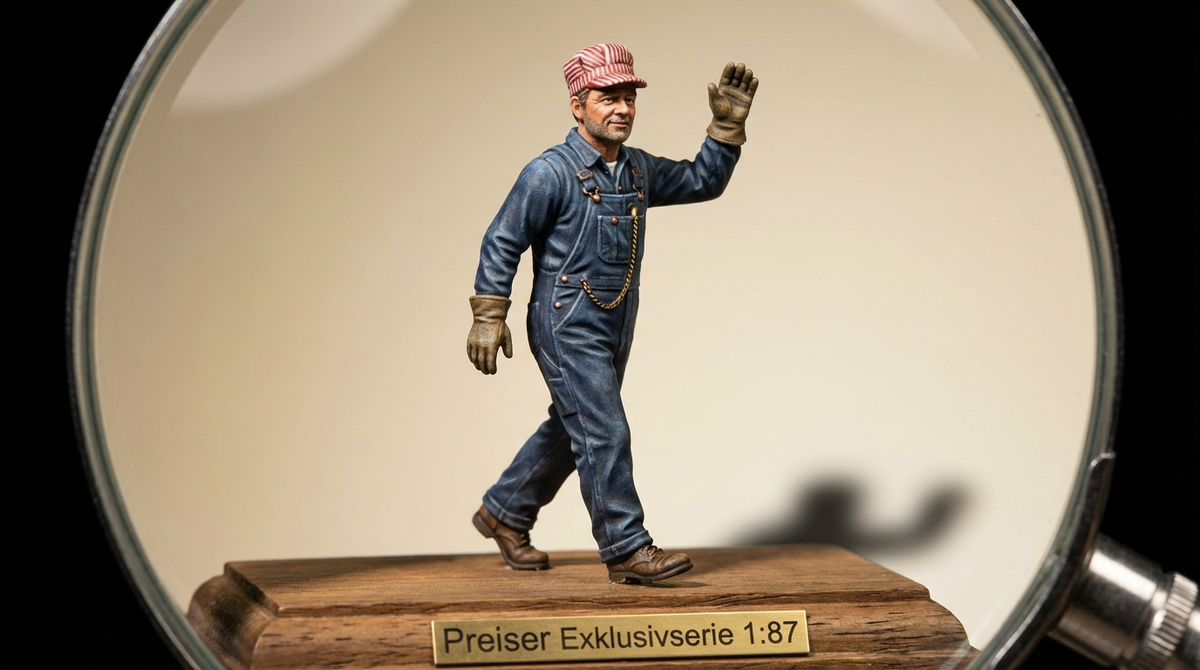
I still remember the moment my HO layout went from "collection of trains" to "believable miniature world." It wasn't a new locomotive or a fancy structure kit. It was a $22 pack of Preiser figures placed on my depot platform. Suddenly, my layout had people. It had stories. That single purchase changed everything about how I approach this hobby.
If you're running HO scale trains, you already know it's the most popular scale in the world. But a layout without figures and accessories feels like a ghost town. Today I'm breaking down everything you need to know about populating your 1:87 scale world without emptying your wallet or losing your mind.
Before you buy a single figure, you need to understand what you're working with. In North America, the NMRA Standard S-1.2 defines HO scale as 3.5mm representing one real foot. That works out to 1:87.1, though most people just say 1:87. European manufacturers follow the MOROP NEM 010 standard at exactly 1:87.
Here's the practical translation: a six-foot-tall person stands about 21mm tall in HO scale. That's your benchmark. When shopping for figures, if the package says the adults are around 20-21mm, you're in the right ballpark.
Here's where newer modelers get burned. British OO scale also runs on 16.5mm track gauge, but it's actually 1:76.2 scale. That means OO figures stand noticeably taller and bulkier than HO figures. A 6-foot person in OO measures about 24mm compared to HO's 21mm. Mix them in the same foreground scene and something will look "off" even if you can't immediately pinpoint why.
Some manufacturers market products as "HO/OO" which can lead to scale inconsistencies. When in doubt, check the actual measurements. A 5% variation in scale is about the limit before proportions start looking wrong.
The 1:87 figure market has something for every budget, and understanding the tiers saves you from overspending where detail won't show and underspending where it will.
| Tier | Price Per Figure | Best Use |
|---|---|---|
| Bulk Unpainted | $0.07 – $0.33 | Passenger car interiors, distant crowds, painting practice |
| Value Pre-Painted | $0.20 – $1.50 | Background street scenes, large industrial workforces |
| Mid-Grade Painted | $1.50 – $4.00 | Mid-distance scenes, secondary focal points |
| Premium Painted | $4.00 – $9.00 | Foreground scenes, depot platforms, dioramas |
| Artisan/Collector | $9.00 – $18.00+ | Hero figures for photography, museum-quality work |
That's a 250x cost difference between the cheapest and most expensive options. The smart play? Reserve your premium figures for foreground "cameo" scenes where viewers will look closely. Fill your passenger cars and background crowds with bulk packs. Nobody's inspecting the third row of faces through a coach window.
Preiser is the name that comes up in every serious figure discussion, and for good reason. This German company has been making miniature figures since 1945, and their HO catalog lists over 1,382 products through major retailers. Their PK 28 catalog spans 336 pages covering everything from their premium "Exklusivserie" to unpainted kits.
What makes Preiser worth the premium? Every figure is injection-molded in plastic and hand-painted. The detail holds up under magnification. Their figures are based on a 1.75m (5'9") person, which translates to about 20mm in HO.
Pricing runs from $5 to $9 for individual figures, with standard 6-figure sets typically costing $15 to $28. If you want to save money, their 120-piece unpainted packs run about €31.95, bringing your cost down to roughly $0.29 per figure. You'll need to paint them yourself, but that's half the fun for many modelers.
Noch specializes in the complete model landscaping ecosystem, but their figure innovation sets them apart. Their 3D Master Figures use full-color 3D printing to produce details impossible with traditional painting. We're talking patterned clothing, realistic color gradients, checked shirts, and striped blouses that would take hours to paint by hand.
Noch also creates Sound Scenes that embed speakers directly into vignettes. Their "Street Musicians" and "Wedding" sets actually play audio. Their Micro-motion products add actual movement to playgrounds and fairgrounds.
For budget-conscious modelers, Noch offers Hobby Figures with simpler paint jobs at lower prices. These work great for populating larger areas where individual detail isn't critical.
Woodland Scenics' Scenic Accents line is specifically designed for 1940s-1950s North American settings. If you're modeling the Transition Era, these are your go-to figures. They're hand-sculpted from plastic resin and hand-painted with natural poses.
Adult figures measure approximately 7/8" (22mm) tall, putting them right in true HO scale territory. Pricing lands in the mid-grade tier, with sets typically ranging from $1.50 to $3.50 per figure.
Their Scenic Accents Glue (A198) is worth mentioning. It stays tacky and allows repositioning without reapplication. If you've ever glued a figure in place and immediately regretted the angle, you'll appreciate this stuff.
Busch excels at micro-accessories and humorous "Action Sets." Their catalog includes over 1,500 products. Some sets push boundaries (yes, there's a nudist BBQ set), but their attention to unique poses and storytelling makes them invaluable for creating distinctive scenes.
Faller is best known for building kits, but their figures are designed with characteristic poses that complement their structures. Their Car System animates road traffic on your layout. They even offer an Advent Calendar with 24 figures for €44.99.
Merten, now owned by Preiser, has a reputation for sculptural quality and unusual subjects. Garden gnomes, pirates, historical themes. Many older sets are discontinued, but what's still available offers good value for hand-painted quality.
Figures need context, and nothing says "scene" like period-appropriate vehicles.
Herpa dominates modern cars and trucks. They've maintained exact 1:87 scale fidelity since 1978, with metallic paints and detailed chrome parts. Their Basic series offers more affordable options.
Wiking covers classic and modern German/European prototypes. They've been adding interiors since 1966 and remain a solid choice for post-WWII modeling.
Brekina is your source for "Golden Age" vehicles from the 1930s through 1980s. Their VW bus line is legendary, and their "Starmada" series offers premium Mercedes-Benz models.
For construction equipment, Kibri (now part of Viessmann) produces detailed excavators, mobile cranes, and industrial structures that pair perfectly with worker figures.
Here's something that surprised me when I started tracking prices: dedicated hobby shops like Burbank's House of Hobbies (which stocks over 230 unique HO figure SKUs) consistently undercut Amazon's average price-per-figure by about 9% after accounting for Prime membership. They also offer better return policies and actual customer service from people who understand the hobby.
For European brands, Modellbahnshop-Lippe in Germany ships internationally with fixed FedEx rates by weight class. Users report 1-2 day delivery to many locations.
UK shops like Rails of Sheffield offer Royal Mail shipping to the USA for £14-£20. Kernow Model Rail Centre provides free UK shipping over £250 and deducts VAT for non-UK orders.
The rise of cheap figures has brought a wave of counterfeits. "Chinese copy Preiserlings" sell at 80-90% discounts but feature sloppy paint jobs and questionable materials.
Red flags include:
For high-value purchases, keep original packaging and log your purchases. The blister pack's front and back, the SKU verification, and purchase receipts all help establish authenticity for potential resale.
Platform protections exist if you get burned. eBay's Money Back Guarantee covers items "not as described" including counterfeits for 30 days. Etsy's Purchase Protection kicks in if sellers don't respond within 48 hours. PayPal gives you 180 days to file a dispute.
The biggest shift in the 1:87 figure market isn't happening in factories. It's happening in home workshops and small print services.
Miniprints in Canada has sold over 33,000 items with a 100% 5-star Google rating. Modelu in the UK even offers custom 3D body scanning so you can put yourself on your layout.
This matters because mass manufacturers have left a gaping hole in modern-era figures. If you model anything after 1980, good luck finding commercially available figures in appropriate clothing. The forum consensus? 3D printing is the answer.
Entry-level resin printers like the Elegoo Mars 4 9K now cost $180-$350. Per-part costs after materials can drop below $1.00 per figure. The trade-off is time. There's a learning curve for slicing, printing, cleaning, and curing. Failed prints from support issues or exposure problems add to your real costs.
Print services like JLC3DP eliminate the learning curve. You upload a file and wait. Turnaround runs 2-10+ days depending on shipping. You pay more per part but absorb zero failure costs.
Before you print anything, understand the intellectual property landscape. The default license on most platforms like Cults and MyMiniFactory prohibits any commercialization. You can print for yourself, but selling prints without a commercial license is both illegal and unethical.
Services like Hive by Cubee3D offer catalogs with full commercial selling rights for membership fees. If you're thinking about selling your prints at train shows, do it right.
Different materials serve different purposes, and understanding the trade-offs saves you money and heartache.
Injection-molded plastic (polystyrene/ABS) offers good detail with high durability. These figures can handle over 1,000 handling cycles without damage. They're cost-effective and widely available.
Cast resin captures razor-sharp details, up to 25% finer than plastic. But resin figures are brittle. They may only survive 250 handling cycles before chipping or breaking.
White metal (pewter alloys) offers precise casting with excellent durability. It can handle over 2,000 handling cycles and has a satisfying weight. The downside? It's more expensive and requires etch primer for paint adhesion.
3D prints fall somewhere in between. Resolution depends on your printer, with modern machines achieving 18-22 micron XY resolution. Standard resins are brittle, but "tough" or "ABS-like" resins improve durability.
The strategic play: use delicate resin figures for protected scenes like cab interiors or behind building windows. Deploy plastic and metal for trackside workers who might get bumped during operation sessions.
Here's a statistic that changed how I approach figure finishing: 74% of complaints about "unrealistic" figures trace back to inappropriate surface sheen. Your figures might have perfect paint jobs, but if they're shiny, they look like plastic toys.
The traditional solution, Testors Dullcote, has a problem. It frosts or blooms in over 40% of applications when humidity exceeds 60%. Newer acrylic formulations solve this. AK Interactive Ultra Matte and Vallejo Mecha Matte deliver dead-flat finishes without humidity issues when airbrushed at a 1:1 thinning ratio at 20 psi.
The golden rule: thin your paints to the consistency of 2% milk. Thick paint obscures detail. Use manufacturer-recommended thinners (Tamiya X-20A for Tamiya acrylics, Vallejo Airbrush Thinner for Vallejo).
Apply multiple thin, translucent layers. Use dark washes in recesses for instant depth. Dry-brushing with lighter shades brings out raised details.
Made a mistake? 90%+ Isopropyl Alcohol strips paint from most plastics safely. Soak for 20-40 minutes, then scrub with a soft toothbrush.
I'm going to be blunt here because nobody talks about this enough. An estimated 58% of modelers use cyanoacrylate (CA) glue accelerators without adequate respiratory protection. The Safety Data Sheets for products like BSI's Insta-Set classify it as a Category 3 Flammable Liquid and Category 1 Aspiration Toxicant.
CA glue fumes have an ACGIH exposure limit of 0.2 ppm. That's not much. Use CA glues and accelerators with proper ventilation and PPE.
Local exhaust ventilation beats relying on room circulation. A small spray booth or fume extractor positioned close to your work area is the most effective solution.
Footprint: 12" x 3"
Create small groups: crew talking, passengers waiting, a family saying goodbye. Weather the platform with light gray and dirt washes.
Footprint: 8" x 8"
Heavy weathering on the floor with oil and grime stains. Pose figures interacting with tools. Use hot water to heat-bend plastic figures into more dynamic poses.
Footprint: 6" x 6"
Arrange animals in natural groups. Cows graze, chickens peck. Place farmer figures with tasks: feeding, carrying tools. Use pinning to secure figures on uneven ground.
Footprint: 4" x 4"
This is where 3D printing becomes essential. Major manufacturers lack modern figures. Source from Miniprints or Modelu, or modify existing figures with 80s-style clothing paint jobs.
Nothing breaks immersion faster than a figure in wrong-era clothing next to a period-specific locomotive.
The NMRA Beginner's Guide breaks North American railroading into distinct periods:
The MOROP NEM 800 standard defines six epochs with country-specific variations. Epoch III (1945-1970) covers post-war reconstruction and the transition from steam. The current 2024 standards maintain this system for international consistency.
My rule: splurge on foreground "hero" figures, save on everything else.
A well-planned 4 sq. ft. depot scene can cost around $105 using a mix of premium foreground figures and value-tier background figures. A 25 sq. ft. club layout area can be populated for $250 by relying heavily on bulk figures with premium pieces reserved for key scenes.
The model railroading community keeps pushing techniques forward. Boulder Creek Railroad (Luke Towan) on YouTube produces master-class tutorials on realistic scenery. Boomer Diorama's HO scale figure painting tutorials focus specifically on the narrative power of miniatures.
Stummiforum.de (German language) offers deep dives into European brands and the community consensus on painting your own figures to achieve custom results affordably. Trains.com forums provide ongoing discussions on techniques and sourcing.
The printer resolution race continues. The Phrozen Sonic Mini 8K S and Elegoo Saturn 3 Ultra 12K achieve XY resolutions as fine as 18-22 microns. The Sonic Mini 8K S launched at $349. As these machines become more affordable, the barrier to producing professional-quality custom figures drops further.
Expect more brands to adopt anti-counterfeiting measures like holograms and QR codes on packaging. IP enforcement will likely increase as 3D printing spreads. Regulatory compliance requirements may reshape how products are packaged and labeled.
The bottom line? We're in a golden age for 1:87 scale figures and accessories. Whether you want hand-painted German craftsmanship or custom 3D-printed modern-era figures, the options have never been better. The key is matching your budget to your viewing distance and your material choices to your handling needs.
Now go populate that layout. Your miniature world is waiting for its people.
By Derek Olson
✨ Complete Your Layout: Explore our wide selection of Photo Real buildings, diorama backdrops, detail parts, and accessories in every popular scale.
✨ Unmatched Realism: From chrome detailing products to neon lighting kits – every piece is designed to make your miniature world come alive.